

You scroll through your browser history and spot a name you don’t recognize. Pinoroduct Com sits between a recipe search and a news article. Did you click it? Did an ad send you there? Should you worry?
Those questions explain why people search for a Pinoroduct com guide. This article gives you straight answers. You’ll learn what outside reviews confirm about the site, what it offers, how its safety checks look, and what steps protect you. Tables, checklists, and three practical scenarios help along the way.
Quick Facts About Pinoroduct Com
Start with the snapshot. This table pulls together what third-party reviews and safety scanners report as of late October 2026.
| Question | Answer |
|---|---|
| Domain | pinoroduct.com |
| Status | Live and publicly reachable |
| Content type | General articles on finance, business, education, health, and technology |
| Online store | No checkout or product listings documented |
| Cost to read | Free |
| Owner | Hidden behind a WHOIS privacy service |
| SSL certificate | Valid |
| Traffic rank | Low on the Tranco list |
| Authors and sources | Articles usually lack named writers and detailed citations |
| Overall trust level | Treat as low-trust reading material |
Keep that last row in mind. It shapes every tip in this guide.
What Is Pinoroduct Com?
Pinoroduct com is a website that publishes informational articles. One detailed review describes it as a multi-topic site covering finance, business, education, health, technology, and general subjects. It isn’t a famous brand or a household name. Most people meet it by accident.
What Sources Confirm
Several points show up again and again across independent write-ups:
- The domain works. Reviewers describe it as a real, publicly accessible, active website.
- It publishes articles. The pages read like general-interest content rather than app screens.
- It isn’t a shop. One review states plainly that it doesn’t operate as a shopping site.
- The owner stays private. ScamAdviser reports that the owner uses a service to hide their identity.
That’s a short list. Still, each item comes from a checkable source.
Why Descriptions of Pinoroduct.com Differ
Read five reviews and you’ll find five different pictures. One calls the site an informational publication. Another calls it a digital tools platform. A third focuses on redirects and ads.
Why the mismatch? Many of these pages guess at the site’s purpose from its name. “Pinoroduct” sounds like “product,” so some writers assume a product site. The actual content tells a different story.
Pro tip: A review that describes features without screenshots, dates, or specific page examples probably didn’t visit the site.
Lookalike Domains: Pinoroduct.com vs. Pinoroducts.com
One letter separates two different addresses. Pinoroduct.com is the domain this guide covers. Pinoroducts.com, with an extra “s,” is a separate domain. Its page describes an online platform for digital tools and web-based solutions.
The two aren’t the same site. Mixing them up leads to wrong conclusions.
| Domain | Described as | Why it matters |
|---|---|---|
| pinoroduct.com | General informational articles | The subject of this guide |
| pinoroducts.com | Platform for digital tools | A different site with a different description |
Typosquatting works the same way. Scammers register near-identical spellings of known names and wait for typos. Always read a URL letter by letter before you type anything into a page.
Pinoroduct Com Features: What the Website Offers
A feature list for this site stays short. It doesn’t run like a software product. You won’t find dashboards, accounts, or interactive tools in any credible description.
Content Topics
Reviews associate the site with these subject areas:
- Finance and business. Money basics, company topics, and general business explainers.
- Education. Study tips and learning-related articles.
- Health. General wellness information.
- Technology. Articles about gadgets, software, and digital habits.
- General subjects. Everyday topics that don’t fit a single category.
Notice the spread. A site that covers finance, health, and tech under one roof usually targets search traffic rather than deep expertise. Specialist publishers tend to stay in one lane.
Layout and Browsing Experience
One guide describes the site as lightweight and minimal, with a simple browsing experience that needs very little interaction. You open an article. You read it. That’s the whole loop.
Performance reports vary. Users commonly describe fast loading when the site is up alongside occasional downtime and inconsistent availability. If a page fails to load one day, that doesn’t signal danger. It does suggest limited infrastructure.
Cost and Access
Reading costs nothing. No source documents a paywall, subscription, or signup requirement. That also means you have no reason to create an account. If a page asks for one, treat it as a warning.
What the Pages Leave Out
Here’s where the site falls short of trusted publishers. Articles usually don’t carry named writers or detailed sources for their claims.
Compare that with a solid information site:
| Trust element | Typical reputable publisher | Pinoroduct com |
|---|---|---|
| Named authors with bios | Yes | Usually not shown |
| Cited sources | Yes | Usually not shown |
| Editorial policy | Yes | Not explained in reviews |
| Contact and ownership details | Yes | Owner hidden |
| Corrections policy | Often | Not documented |
Those gaps matter most for health and money topics. A wrong tip about a recipe costs you dinner. A wrong tip about medication or investing costs far more.
How People Use Pinoroduct Com

Visitors fall into three groups. Each group has a different best practice.
Background Reading on General Topics
Some readers land on a page through a search and skim it for basics. That use carries little risk. Treat the content like a conversation with a stranger at a bus stop. It might spark an idea. It shouldn’t settle a decision.
A Starting Point for Research
Others use articles to learn vocabulary before digging deeper. For example, a reader curious about budgeting might pick up terms like “emergency fund” and then verify details on a government or bank education page.
That workflow makes sense. The article opens the door and a stronger source finishes the job.
Landing There by Accident
The third group never chose the site. Pinoroduct com can show up in browser history because of ad redirects or background activity from other sites, even without a direct click.
If that describes you, the visit itself doesn’t prove you did anything wrong. It does tell you where to look next. Check which site sent you there and review your extensions.
Scenario: The Mystery History Entry
This illustrative scenario shows a common pattern.
Dana notices Pinoroduct com in her laptop history. She doesn’t remember visiting. She checks the timestamp and finds it matches a visit to a free streaming site the night before.
She takes four steps:
- She closes the streaming site’s tab for good.
- She clears cookies for both domains.
- She reviews her browser extensions and removes one she doesn’t recognize.
- She runs a malware scan.
The scan comes back clean. Dana’s habit change matters most: she stopped clicking “allow notifications” on unfamiliar sites.
Is Pinoroduct Com Safe? What the Checks Show
Safety questions deserve evidence. Start with what automated scanners report.
ScamAdviser Findings
ScamAdviser’s report on pinoroduct.com lists both strengths and weaknesses. Positive points include a valid SSL certificate, a domain registered more than a year ahead, and a “safe” rating from DNSFilter. Negative points include hidden WHOIS ownership, a low Tranco rank, and a registrar with a high percentage of spam and fraud sites.
Here’s the same information in table form:
| Signal | Finding | Effect on trust |
|---|---|---|
| SSL certificate | Valid | Positive |
| Domain registration length | Registered over a year ahead | Positive |
| DNSFilter | Marked safe | Positive |
| WHOIS owner details | Hidden by privacy service | Negative |
| Tranco rank | Low | Neutral to negative |
| Registrar reputation | High share of spam and fraud sites | Negative |
| Scan freshness | Not rescanned in over 30 days | Caution |
The report’s summary calls the site very likely not a scam. That’s a cautious conclusion. It doesn’t say “trusted.”
Why a Padlock Doesn’t Equal Trust
Many people read the browser padlock as a stamp of approval. It isn’t. HTTPS encrypts the connection between you and the server. It says nothing about who runs the server.
Free certificate authorities such as Let’s Encrypt have issued certificates automatically since 2015. A scam site can display the same padlock as your bank. One review also asks directly whether HTTPS makes the site trustworthy. The answer is no.
Why Hidden WHOIS Is a Weak Signal Alone
Hidden ownership sounds alarming. Context softens it. Since Europe’s GDPR took effect in 2018, many registrars redact registrant details by default. Plenty of honest small sites use privacy services to avoid spam.
So hidden WHOIS alone proves nothing. Combine it with missing author names, missing contact details, and a missing editorial policy though. Then the pattern becomes meaningful.
Reading vs. Interacting
Risk depends on what you do. The table below separates the two.
| Action | Risk level | Reason |
|---|---|---|
| Reading an article | Low | Browsers sandbox normal pages |
| Clicking an ad on the page | Medium | Ads can lead to unrelated sites |
| Allowing notifications | Medium to high | Enables pop-up spam after you leave |
| Downloading a file | High | Files can carry malware |
| Entering email or passwords | High | Data may reach unknown parties |
| Entering payment details | Very high | No store is documented on this site |
One review notes that simply reading articles on the site is usually low risk. That matches the table.
Redirects and Heavy Ads
Redirects deserve their own warning. The site is linked with situations where users experience redirects or heavy advertising. Redirect chains can send you from an article to a survey page or a fake alert.
If a page claims your device is infected, close it. Real security warnings never come from a random website tab.
Pinoroduct Com Safety Tips
Good habits beat paranoia. Use these tips on any unfamiliar site. They apply especially well to Pinoroduct.com.
Before You Click
- Read the URL. Confirm the exact spelling and watch for the extra “s” in lookalikes.
- Search the domain name plus “review.” Check more than one result and compare dates.
- Look for an About page. Real publishers say who they are.
- Check for a privacy policy. Sites that collect data should explain how.
- Skip links from pop-ups or unsolicited messages. Type the address yourself instead.
While You Browse
- Decline notification prompts. Browsers ask permission before a site can send push messages. Click “Block.”
- Ignore “update your browser” banners. Updates come from your browser menu only.
- Avoid downloads. An article page has no reason to hand you a file.
- Skip forms. Don’t enter your name, email, phone, or payment details.
- Use an ad blocker. It cuts redirects and misleading banners.
- Keep your browser current. Security patches close the holes that bad ads exploit.
Pro tip: Open unfamiliar sites in a private window. It won’t save logins, and it limits how long cookies stick around.
If Something Goes Wrong
Act fast but stay calm. Follow this order:
- Close the tab. Don’t click anything inside the page.
- Clear site data. Remove cookies and cached files for the domain.
- Revoke notification permission. Open your browser’s site settings and block the site.
- Review extensions. Remove anything you don’t recognize.
- Run a malware scan. Use your operating system’s built-in tool or a trusted scanner.
- Change passwords. Do this if you typed any login on the page. Start with email and banking.
- Call your bank. Do this if you entered card details. Ask about a replacement card and fraud alerts.
- Report it. Use your country’s consumer protection or fraud reporting channel.
Scenario: The Student Who Almost Trusted a Health Tip
Another illustrative scenario.
Marcus lands on a Pinoroduct com article about sleep habits. The advice sounds reasonable. He wants to share it with his study group.
First he looks for an author. He finds none. Next he looks for references. He finds none of those either. So he searches the key claim on a university health site. He finds a similar but more careful version with real citations.
Marcus shares the university page. The Pinoroduct com article gave him the idea. A credible source gave him the facts.
How to Check Pinoroduct Com Yourself
Reviews help but they age quickly. Anyone can run these checks in about ten minutes. The tools below are free.
| Tool | What it shows | Link |
|---|---|---|
| ICANN Lookup | Domain registration date and registrar | lookup.icann.org |
| Wayback Machine | Old snapshots of the site over time | web.archive.org |
| Google Safe Browsing | Whether Google flags the site for malware or phishing | transparencyreport.google.com/safe-browsing/search |
| ScamAdviser | Automated trust score and risk flags | scamadviser.com |
A Ten-Minute Audit
Work through these steps in order.
- Check the registration date. Use ICANN Lookup. Newer domains deserve more caution.
- Review site history. The Internet Archive has saved web pages since 1996. Compare old snapshots with today’s pages. Big changes in topic can signal a repurposed domain.
- Run Safe Browsing. A clean result is good. It isn’t a guarantee.
- Scan the page for trust signals. Look for authors, dates, sources, contact details, and policies.
- Test one claim. Pick a fact from an article and verify it on a primary source.
- Search for independent discussion. One review reports that the site doesn’t appear on known review platforms, business directories, or social media. Check whether that still holds.
- Write down your verdict. Decide how much weight the site deserves. Record the date.
That last step helps. Sites change. A verdict from October 2026 may not hold in April 2027.
Is Pinoroduct Com Legit? A Fair Verdict
“Legit” can mean two things. It can mean the site exists and works. It can also mean the site deserves your trust. Those are different questions.
On the first question, the answer is yes. One review stresses that a domain can display working pages without proving its operator is trustworthy. The site passes the basic test of being a real, active website.
On the second question, the evidence says be careful. The scorecard below weighs the key factors.
| Factor | Finding | Verdict |
|---|---|---|
| Site exists and loads | Yes | Pass |
| SSL certificate | Valid | Pass |
| Marked safe by DNSFilter | Yes | Pass |
| Not flagged as a scam by ScamAdviser | Correct | Pass |
| Owner identified | No | Fail |
| Named authors | No | Fail |
| Cited sources | Rarely | Fail |
| Independent reviews on major platforms | Not found by at least one review | Fail |
| Redirect or heavy ad reports | Yes | Caution |
Five clear signals point one way and four point the other. The balanced reading: Pinoroduct com isn’t documented as a scam but doesn’t earn high trust either. Use it for light reading. Don’t use it for health, legal, or money decisions.
Why Pinoroduct Com Reviews Contradict Each Other
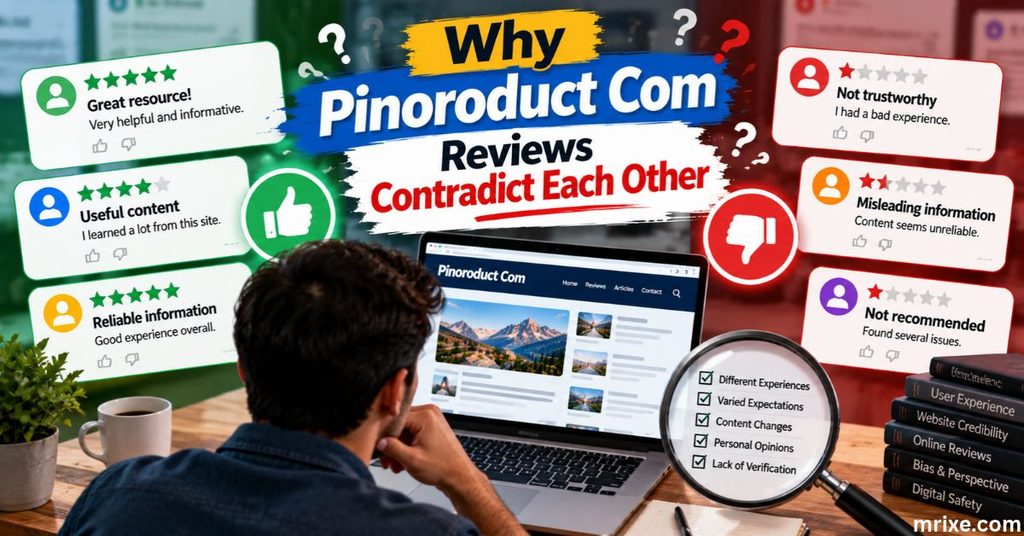
Search the name and you’ll see conflicting claims. Understanding why helps you filter noise.
Many reviews are written for search traffic. Publishers chase trending keywords. A thin review on a new keyword can draw clicks even when the writer never visited the site.
Dates mislead. One review notes that a “2026” label may look current only because of its publication date. A page titled “2026” can still repeat facts from a year earlier.
Descriptions copy each other. One writer guesses. Others rephrase the guess. Soon five pages agree on something nobody verified.
Sites change. A domain can host one kind of content in spring and another in fall. Old reviews describe old content.
Use this quick filter on any review:
- Does it name specific pages or screenshots?
- Does it show the date of the author’s visit?
- Does it separate confirmed facts from guesses?
- Does it link to checkable tools?
A review that answers “no” to all four deserves little weight.
One guide even labels the site a “Standard Trusted Website” in a comparison table while also admitting that company identity, contact details, and legal policies aren’t clearly available. That contradiction shows why you shouldn’t trust labels. Check the evidence.
Should You Buy a Backlink From Pinoroduct Com?
Marketers ask this often. Pinoroduct.com content sometimes appears in lists of sites that sell guest posts or links. The question matters if you run a website.
Google’s spam policies list buying or selling links that pass ranking credit as a violation. A paid link on a low-traffic, multi-topic site carries two risks:
- Ranking risk. Google may ignore the link or penalize patterns that look manipulative.
- Reputation risk. Your brand appears next to unrelated finance, health, and tech articles.
A better path exists. Earn links through original research, useful tools, and real partnerships. Those links last.
Scenario: The Small Business Owner
A final illustrative scenario.
Priya runs a bakery blog. A seller offers her a Pinoroduct com guest post for a flat fee. The pitch promises “authority.”
She checks the site. She sees no author names, no industry focus, and low traffic. She also sees that most articles have nothing to do with food. She declines. Instead she pitches a local newspaper a story about her bakery’s charity bake sale. The paper runs it and links to her site for free.
How to Judge Content Quality on Any Information Site
The same checklist works for Pinoroduct.com and every other unfamiliar publisher. Score each item.
| Quality check | Strong sign | Weak sign |
|---|---|---|
| Authorship | Named expert with credentials | No byline |
| Sources | Links to studies, laws, or official data | Vague phrases like “experts say” |
| Date | Clear publish and update dates | No date or an old date relabeled |
| Focus | Site stays in a lane | Random topics across the board |
| Depth | Answers follow-up questions | Repeats the headline in paragraph form |
| Corrections | Visible correction policy | No sign of edits |
| Ads | Clearly labeled and minimal | Pop-ups and redirects |
Three or more weak signs call for outside verification. Two or fewer weak signs still deserve a spot check.
For high-stakes topics, raise the bar. Health and money advice should come from medical bodies, government agencies, or licensed professionals. A general article can introduce a topic. It shouldn’t guide a treatment or a loan.
If You Came Looking for Product Reviews
Some visitors expect Pinoroduct com to review gadgets. The site isn’t documented as a product review source. It doesn’t sell hardware either. If you need to compare products, use sources built for that purpose.
Reliable product research usually combines these inputs:
- Manufacturer spec sheets. They list exact dimensions, ports, battery size, and warranty terms.
- Independent testing labs. They measure performance the same way across products.
- Review outlets that disclose methods. Look for pages that explain how they test and how they earn money.
- Owner reviews on several retailers. Read the three-star reviews first. They tend to be the most specific.
- Return policies. A generous return window protects you when reviews disagree.
A simple habit helps. Check at least three independent sources before any purchase over a few dozen dollars. Read the newest reviews first because firmware updates change how products behave.
Conclusion
Pinoroduct com is a real website that publishes general articles. It isn’t a store and it doesn’t run like a software platform. Safety scanners see a valid certificate and no scam flag. They also see a hidden owner, a low traffic rank, and a registrar with a poor reputation.
The practical takeaway is simple. Reading an article carries low risk. Trusting an article for health or money decisions carries high risk. Entering personal details on the site carries no benefit at all.
Build three habits. Check the URL before you click. Verify important claims on stronger sources. Block notification prompts and pop-ups. Those habits protect you on Pinoroduct.com and on every unfamiliar site you meet next.
Frequently Asked Questions About Pinoroduct Com
Is Pinoroduct Com a real website?
Yes. Multiple reviews describe pinoroduct.com as a live, publicly accessible site that publishes articles. A working domain doesn’t prove the operator is trustworthy though.
Is Pinoroduct Com an online store?
No documented evidence shows a shop. Reviews describe informational content with no checkout flow. Avoid entering payment details on any page of the site.
Is Pinoroduct Com safe to visit?
Reading articles carries low risk. Risk rises if you click ads, allow notifications, or download files. Use an ad blocker and keep your browser updated.
Why did Pinoroduct Com show up in my browser history?
Ad redirects and background activity from other sites can add entries without a deliberate click. Check the visit time against what you were doing. Review your extensions and clear site data.
Who owns Pinoroduct Com?
The owner uses a WHOIS privacy service to hide registration details. That’s the documented fact. You can run your own lookup at ICANN Lookup to see current registrar information.
Is Pinoroduct Com a scam?
Documented evidence doesn’t label it a scam. ScamAdviser’s report calls it very likely not a scam. That doesn’t make it a trusted source. Missing authors, missing sources, and hidden ownership still call for caution.
Is pinoroduct.com the same as pinoroducts.com?
No. They are two separate domains. Pinoroducts.com carries an extra “s” and describes itself differently. Read the full URL before you trust a page.
What should I do if I entered information on Pinoroduct Com?
Change any password you typed and turn on two-factor authentication. Contact your bank if you entered card details. Run a malware scan and review your browser extensions. Report the incident to your local consumer protection agency.

Nathan Cooper is a humor writer who enjoys creating clever puns, witty jokes, and lighthearted content that brings smiles to readers. He loves sharing fresh, family friendly humor that’s fun, engaging, and easy to enjoy.