

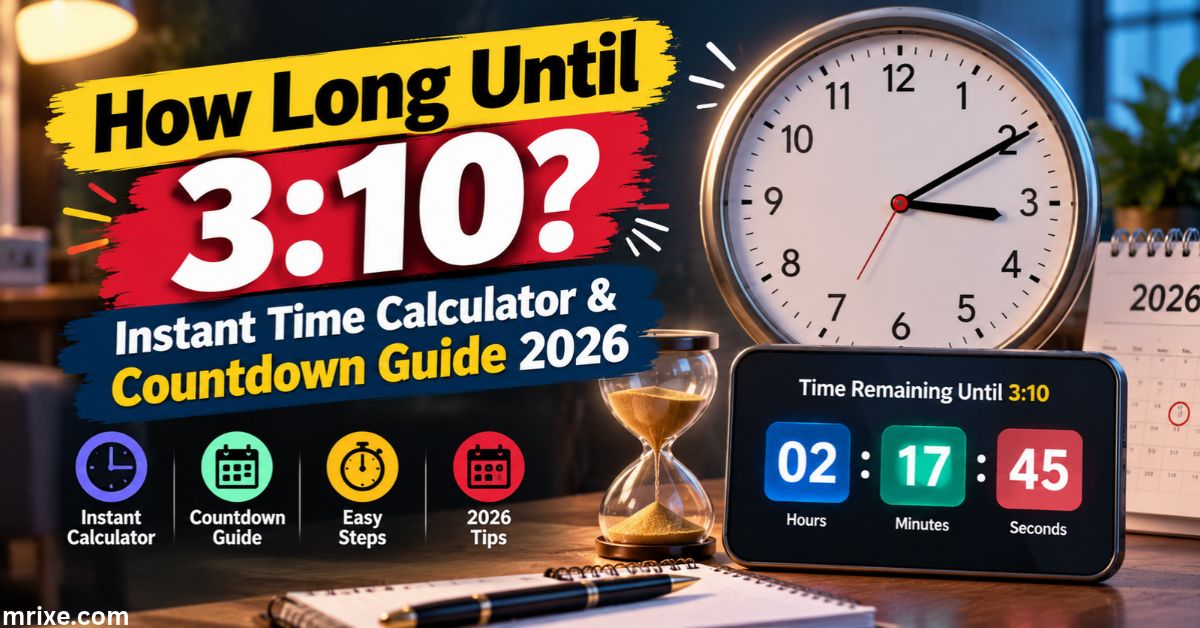
You glance at the clock. Something important happens at 3:10, and you need a number right now. Maybe school lets out. Maybe a meeting starts. Maybe your shift ends.
If you’re wondering how long until 3:10, this guide gives you the answer in seconds. It also teaches you to work it out yourself, anywhere and anytime, with no app.
How Long Until 3:10?
Live countdown to the next 3:10 PM and 3:10 AM.
Based on your device’s local time.
You'll find a full reference table, four simple steps, worked examples, and a mental math trick. We'll also cover time zones and the 2026 daylight saving dates. Those two catch plenty of people off guard.
Short on time? Subtract the current time from 3:10. If the answer is negative, add 24 hours. That's the whole formula.
Quick Answer: How Long Until 3:10?
Here's the fast version. Take the current time and subtract it from 3:10. If you get a negative number, the 3:10 you want has already passed today. Add 24 hours to find the wait for the next one.
The answer depends on two things. First, do you mean 3:10 AM or 3:10 PM? Second, what time is it where you are right now? Your device clock settles the second question. You settle the first.
If you don't specify AM or PM, count to whichever 3:10 comes next on the clock. That's usually what people mean when they ask how much longer until 3:10.
Here's a quick cheat sheet:
- At noon, 3:10 PM is 3 hours 10 minutes away.
- At 2:00 PM, it's 1 hour 10 minutes away.
- At 3:00 PM, it's just 10 minutes away.
- At midnight, 3:10 AM is 3 hours 10 minutes away.
Time Remaining Until 3:10 PM and 3:10 AM: Full Reference Table
Math takes a few seconds. A lookup table takes one. This table lists the time until 3:10 for every hour on the clock, for both AM and PM.
Find your current time in the left column. Then read across.
| Current Time | Until 3:10 PM | Until 3:10 AM |
|---|---|---|
| 12:00 AM (midnight) | 15h 10m | 3h 10m |
| 1:00 AM | 14h 10m | 2h 10m |
| 2:00 AM | 13h 10m | 1h 10m |
| 3:00 AM | 12h 10m | 10m |
| 4:00 AM | 11h 10m | 23h 10m |
| 5:00 AM | 10h 10m | 22h 10m |
| 6:00 AM | 9h 10m | 21h 10m |
| 7:00 AM | 8h 10m | 20h 10m |
| 8:00 AM | 7h 10m | 19h 10m |
| 9:00 AM | 6h 10m | 18h 10m |
| 10:00 AM | 5h 10m | 17h 10m |
| 11:00 AM | 4h 10m | 16h 10m |
| 12:00 PM (noon) | 3h 10m | 15h 10m |
| 1:00 PM | 2h 10m | 14h 10m |
| 2:00 PM | 1h 10m | 13h 10m |
| 3:00 PM | 10m | 12h 10m |
| 4:00 PM | 23h 10m | 11h 10m |
| 5:00 PM | 22h 10m | 10h 10m |
| 6:00 PM | 21h 10m | 9h 10m |
| 7:00 PM | 20h 10m | 8h 10m |
| 8:00 PM | 19h 10m | 7h 10m |
| 9:00 PM | 18h 10m | 6h 10m |
| 10:00 PM | 17h 10m | 5h 10m |
| 11:00 PM | 16h 10m | 4h 10m |
A few more reference points:
| Current Time | Until 3:10 PM | Until 3:10 AM |
|---|---|---|
| 1:50 PM | 1h 20m | 13h 20m |
| 3:10 PM | Now | 12h 0m |
| 4:20 PM | 22h 50m | 10h 50m |
| 10:30 PM | 16h 40m | 4h 40m |
Note: The table assumes no clock change falls between now and 3:10. On a daylight saving date, add or subtract one hour. We'll cover that shortly.
Notice the pattern. The two columns always add up to 24 hours when you count from the same moment. Check any row. At 6:00 AM you have 9h 10m to 3:10 PM and 21h 10m to the next 3:10 AM. Together, that's 30h 20m. That's not 24 because 3:10 PM comes before the next 3:10 AM, so the second wait includes an extra half day. The simpler rule is that 3:10 AM and 3:10 PM sit exactly 12 hours apart.
How to Calculate the Exact Time Until 3:10
You don't need a calculator. Four small steps handle every case. Once you've tried them a few times, you'll do them in your head.
Decide Whether You Mean AM or PM
Start here. It's the step most people skip. It's also where most errors begin.
3:10 AM is the middle of the night. 3:10 PM is mid-afternoon. They're 12 hours apart. Pick the right one before you count anything.
Not sure which one you mean? Use the next one on the clock. At 1:00 PM, the next 3:10 is PM. At 8:00 PM, the next 3:10 is AM.
Convert Both Times to 24-Hour Format
The 24-hour clock removes AM and PM confusion. Each hour has its own number from 00 to 23.
- 3:10 AM becomes 03:10
- 3:10 PM becomes 15:10
- 1:00 PM becomes 13:00
- 11:45 PM becomes 23:45
Here's the rule. For AM times, keep the hour (except 12 AM, which becomes 00). For PM times, add 12 (except 12 PM, which stays 12).
Quick conversion list:
- 12:00 AM = 00:00
- 6:00 AM = 06:00
- 12:00 PM = 12:00
- 1:00 PM = 13:00
- 6:00 PM = 18:00
- 11:00 PM = 23:00
Subtract Your Current Time From the Target Time
Now do the subtraction. Target minus current time gives you the wait.
Suppose it's 13:50 and your target is 15:10. Subtract 13:50 from 15:10. You get a result of 1 hour 20 minutes after you handle the minutes.
What if the result is negative? That means 3:10 already passed today. Add 24 hours to get the wait for tomorrow's 3:10.
Break the Result Into Hours and Minutes
Minutes trip people up. An hour has 60 minutes, not 100. When the minutes come out negative, borrow one hour and add 60.
Try it with 15:10 minus 13:50:
- Hours: 15 − 13 = 2
- Minutes: 10 − 50 = −40
- Minutes are negative, so borrow: 2 hours becomes 1 hour, and −40 becomes 20 minutes
- Answer: 1 hour 20 minutes
That borrowing step is the same one you learned in grade school. It just uses 60 instead of 10.
Worked Examples: Time Until 3:10 in Real Situations
Examples make the method stick. Here are four common cases.
Before the Target, Same Day
It's 11:45 AM. How long until 3:10 PM?
- Convert: 11:45 AM = 11:45. 3:10 PM = 15:10.
- Hours: 15 − 11 = 4
- Minutes: 10 − 45 = −35
- Borrow: 3 hours and 25 minutes
Answer: 3 hours 25 minutes.
Borrowing Minutes
It's 1:50 PM. How long until 3:10 PM?
- Convert: 13:50 to 15:10
- Hours: 2
- Minutes: −40, so borrow
- Result: 1 hour 20 minutes
Answer: 1 hour 20 minutes.
The Target Has Already Passed
It's 4:20 PM. How long until the next 3:10 PM?
- Convert: 16:20 to 15:10
- Subtract: 15:10 − 16:20 = −1 hour 10 minutes
- Negative, so add 24 hours: 24:00 − 1:10 = 22 hours 50 minutes
Answer: 22 hours 50 minutes.
Crossing Midnight
It's 10:30 PM. How long until 3:10 AM?
- Convert: 22:30 to 03:10
- Subtract: 03:10 − 22:30 = −19 hours 20 minutes
- Add 24 hours: 4 hours 40 minutes
Answer: 4 hours 40 minutes.
Here's a second way to handle midnight crossings. Count to midnight first. From 10:30 PM that's 1 hour 30 minutes. Then add the 3 hours 10 minutes after midnight. The total is 4 hours 40 minutes. Same answer.
A Faster Way: The Count-to-the-Hour Trick
Subtraction works fine. Still, many people find another method quicker when they ask how much longer until 3:10. It's called counting up to the hour.
Here's how it works:
- Count the minutes to the next full hour.
- Count the whole hours until you reach 3:00.
- Add the final 10 minutes.
Example from 1:50 PM:
- 10 minutes to reach 2:00
- 1 hour to reach 3:00
- 10 minutes more to reach 3:10
- Total: 1 hour 20 minutes
It feels like counting on your fingers. Because it is. That's why it's fast.
The Minutes-After-Midnight Method
Prefer numbers? Convert each time to total minutes after midnight and subtract.
- 3:10 AM = 3 × 60 + 10 = 190 minutes
- 3:10 PM = 15 × 60 + 10 = 910 minutes
- 1:50 PM = 13 × 60 + 50 = 830 minutes
Then 910 − 830 = 80 minutes. That's 1 hour 20 minutes.
This method shines for spreadsheets and code. It avoids the borrowing step completely.
Time Until 3:30 and Time Until 2:25: Same Method, Different Targets
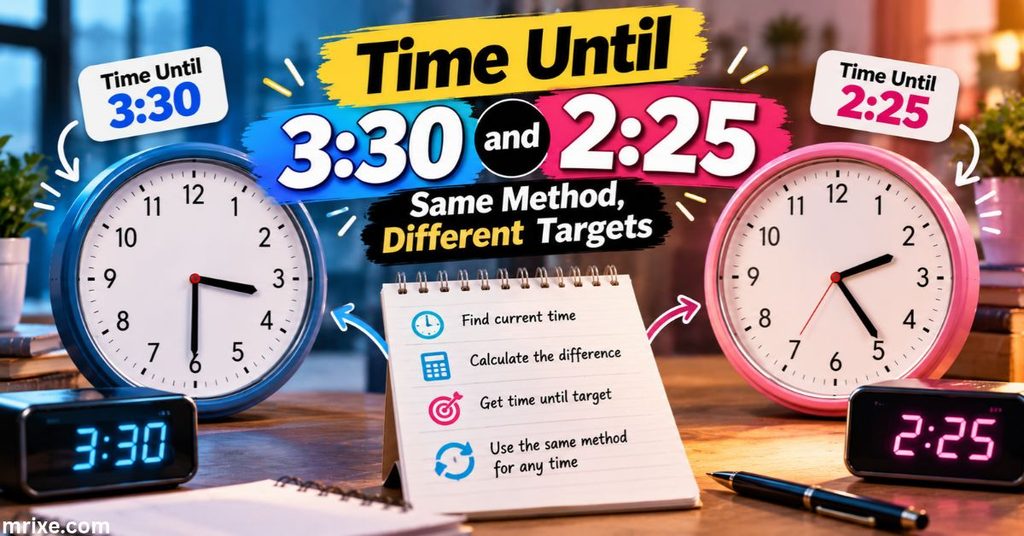
Plenty of people ask about nearby times too. After all, school bells, meetings, and appointments rarely land on 3:10 exactly. The good news is the method doesn't change. Only the target does.
Say you want the time until 3:30 PM. Swap 15:10 for 15:30 in your subtraction. Wondering how much time until 3:30 from 1:50 PM? Count 10 minutes to 2:00, one hour to 3:00, and 30 more minutes. That's 1 hour 40 minutes.
Likewise, the time until 2:25 from 1:50 PM is 10 minutes plus 25 minutes. That's 35 minutes.
Here's a comparison table so you can see all three targets side by side:
| Current Time | Until 2:25 PM | Until 3:10 PM | Until 3:30 PM |
|---|---|---|---|
| 9:15 AM | 5h 10m | 5h 55m | 6h 15m |
| 10:30 AM | 3h 55m | 4h 40m | 5h 0m |
| 11:45 AM | 2h 40m | 3h 25m | 3h 45m |
| 12:00 PM | 2h 25m | 3h 10m | 3h 30m |
| 1:50 PM | 35m | 1h 20m | 1h 40m |
| 2:00 PM | 25m | 1h 10m | 1h 30m |
| 2:25 PM | Now | 45m | 1h 5m |
| 3:00 PM | Passed (23h 25m to next) | 10m | 30m |
Handy facts about these targets in 24-hour time:
- 2:25 PM = 14:25 = 865 minutes after midnight
- 3:10 PM = 15:10 = 910 minutes after midnight
- 3:30 PM = 15:30 = 930 minutes after midnight
The gap between 3:10 and 3:30 is always 20 minutes. The gap between 2:25 and 3:10 is always 45 minutes. Use those fixed gaps as shortcuts. If you know the wait for one, you can quickly adjust for the others.
AM vs. PM: Where Most Errors Start
Ask anyone who has missed an early flight. Chances are the AM/PM mix-up played a role.
Here's the core fact: 3:10 AM and 3:10 PM are exactly 12 hours apart. That's a huge gap. Choose the wrong one and your countdown is off by half a day.
Why 12 AM and 12 PM Cause Confusion
The 12-hour clock has an odd quirk. The number 12 shows up at both noon and midnight. Many people mix them up.
- 12:00 AM is midnight. It starts a new calendar day.
- 12:00 PM is noon. It marks the middle of the day.
Both sound backward at first. After all, "AM" sounds like "morning," and noon isn't really morning. The letters actually stand for Latin phrases. AM means ante meridiem (before midday). PM means post meridiem (after midday). Noon is the meridiem itself, so it doesn't fit neatly into either group.
For this reason, many scheduling guides suggest writing "noon" or "midnight" in plain words. It removes all doubt.
Where Phones and Calendars Trip You Up
Alarms and calendar invites often default to a half of the day. If you set an alarm for "3:10" and tap too fast, your phone may pick AM when you wanted PM. Always check the little AM/PM label before you save.
Calendar invites can also hide the problem. A meeting you created late at night may land at 3:10 AM by accident. Double-check the invite after you send it.
Time Zones: Which 3:10 Do You Mean?
Your clock says one thing. Your coworker's clock says another. So which 3:10 counts?
Always confirm the zone before you start counting. A single "3:10 PM" can mean four different moments across the continental United States.
Here's how one meeting plays out:
| Time Zone | Local Time When It's 3:10 PM Eastern |
|---|---|
| Eastern | 3:10 PM |
| Central | 2:10 PM |
| Mountain | 1:10 PM |
| Pacific | 12:10 PM |
Each zone sits one hour behind the one to its east. So Eastern to Pacific is a three-hour gap.
How to Handle a Cross-Zone Countdown
Follow these steps:
- Find the zone listed on the invite or schedule.
- Convert that time into your own zone.
- Subtract your current local time from the converted time.
Say you live in Chicago and a webinar starts at 3:10 PM Pacific. That's 5:10 PM Central. If it's 2:00 PM where you are, you have 3 hours 10 minutes to go.
Two free tools help here. The time.gov site shows the official U.S. time. The timeanddate.com time zone converter handles conversions between almost any pair of cities. Both save you from doing the math twice.
Daylight Saving Time in 2026 and Your Countdown
Daylight saving time changes the clock twice a year. It can quietly wreck a countdown if you don't plan for it.
Under current U.S. law, the 2026 dates are:
- Spring forward: Sunday, March 8, 2026. At 2:00 AM, clocks jump to 3:00 AM.
- Fall back: Sunday, November 1, 2026. At 2:00 AM, clocks return to 1:00 AM.
You can confirm these dates on the timeanddate.com U.S. daylight saving page. Since the fall change is still ahead of us in 2026, mark it on your calendar.
What Happens to a 3:10 AM Countdown
3:10 AM sits right next to the clock change. That makes it a tricky target.
On March 8, 2026 (spring forward):
The hour from 2:00 to 3:00 AM never happens. Clocks skip straight ahead. If you start counting at 1:00 AM, the clock math says 2 hours 10 minutes. The real wait is only 1 hour 10 minutes. You lose an hour.
On November 1, 2026 (fall back):
The 1:00 AM hour happens twice. If you start counting at the first 1:00 AM, the real wait is 3 hours 10 minutes. If you start at the second 1:00 AM, the wait is 2 hours 10 minutes. You gain an hour.
Quick adjustment rules:
- Spring forward night: subtract 1 hour from any wait that crosses 2:00 AM.
- Fall back night: add 1 hour to any wait that crosses 2:00 AM.
- A 3:10 PM countdown on those same dates is not affected if you start after 3:00 AM that day.
Who Skips Daylight Saving Time?
Not everyone changes their clocks. Most of Arizona stays on standard time all year. The Navajo Nation inside Arizona is the exception because it does observe daylight saving. Hawaii also skips it. The same goes for several U.S. territories.
So if you work with people in Phoenix, expect their gap with other zones to shift during the year. In summer, Arizona matches Pacific Time. In winter, it matches Mountain Time.
"Lost time is never found again."
— Benjamin Franklin, Poor Richard's Almanack (commonly attributed)
Franklin never meant the line for clock changes. Still, it fits. Miss a daylight saving shift and you'll lose an hour you can't get back.
Why People Search for the Time Until 3:10
The question sounds simple. The reasons behind it are varied and very real. Here are the most common.
- School pickup and dismissal. Many U.S. schools end the day in the 2:30 to 3:30 PM window.
- Meetings and appointments. Calls, interviews, and medical visits often start on odd times like 3:10.
- Shift changes. Hospitals, warehouses, and factories frequently schedule changes in mid-afternoon.
- Transit. Buses, trains, and flights depart on exact minutes.
- Medication reminders. Timed doses need accurate gaps.
- Cooking and timed tasks. Slow cooking, proofing dough, and lab work all run on timers.
Case Study: The School Pickup Parent
This is an example scenario.
Maria works from home in Dallas. Her son's school lets out at 3:10 PM. The drive takes 15 minutes. She wants to leave early enough to get a spot in the pickup line, which fills fast.
At 1:40 PM she checks the clock. The time until 3:10 is 1 hour 30 minutes. She subtracts the 15-minute drive and a 15-minute line buffer. That leaves her until 2:40 PM to wrap up. She sets one alarm for 2:35 PM and one for 2:40 PM.
The result? She arrives on time and keeps her work schedule intact. A quick calculation beat guessing.
Case Study: The Night Shift Nurse
This is an example scenario.
James is a nurse in Phoenix. His shift ends at 3:10 AM. He works the night of the spring daylight saving change in a state that does not observe it, so his clock stays steady. His sister in Denver, however, plans to call him at 3:10 AM Mountain Time.
In March, Denver jumps forward but Phoenix doesn't. So the gap between the two cities changes by an hour. James checks the converter at timeanddate.com. He learns his sister's 3:10 AM call will reach him at 2:10 AM Phoenix time. He adjusts his break plans and avoids a missed call.
The lesson is simple. Always check zones and clock changes before you rely on a countdown.
Case Study: The Evening Commuter
This is an example scenario.
Priya leaves work at 5:00 PM and wants to know how long until her 3:10 AM flight departs. That's 10 hours 10 minutes from 5:00 PM. She subtracts a 2-hour airport arrival window and a 45-minute drive. That puts her departure from home at about 12:25 AM.
She also notices the date. The flight falls on November 1, so the clocks fall back that night. She calls the airline. They confirm the departure time is a real clock time. Her wait is actually an hour longer than the clock math suggests. She plans an extra hour of sleep and sets her alarm accordingly.
Common Mistakes and Quick Fixes
Most countdown errors fall into five groups. Spot them early and you'll rarely miss a deadline.
| Mistake | Quick Fix |
|---|---|
| Ignoring AM or PM | State which one you mean before you count |
| Forgetting the rollover after 3:10 | Add 24 hours when the result is negative |
| Treating an hour as 100 minutes | Borrow 60 minutes, never 100 |
| Mixing time zones | Convert both times to one zone first |
| Overlooking a clock change | Check the date against the daylight saving schedule |
| Rounding too early | Keep exact minutes until the final step |
| Misreading 12:00 | Remember 12 AM is midnight and 12 PM is noon |
Do This
- Write down both times in 24-hour format.
- Double-check AM and PM on every alarm.
- Confirm time zones on every invite.
- Check the date if it falls near March 8 or November 1.
Avoid This
- Guessing in your head when the wait is long.
- Trusting an old screenshot of a countdown.
- Assuming everyone observes daylight saving.
- Counting only the clock when you cross midnight.
Tools That Track the Time Until 3:10 for You
Doing the math is a useful skill. Still, tools can do it faster when stakes are high.
Phone and Voice Assistants
Every major phone has a built-in timer. Open the clock app. Choose Timer. Enter the hours and minutes you calculated. Press start. You'll get an alert the second time runs out.
You can also say, "Set a timer for 1 hour and 20 minutes." Both Siri and Google Assistant handle that.
Alarms work differently. An alarm fires at a clock time, not after a gap. If your goal is "wake me at 3:10 PM," use an alarm. If your goal is "remind me in 80 minutes," use a timer.
A Spreadsheet Formula
Spreadsheets handle time as a fraction of a day. This formula returns the time left until the next 3:10 PM:
=MOD(TIME(15,10,0)-MOD(NOW(),1),1)
Format the cell as [h]:mm and you'll see hours and minutes. Change TIME(15,10,0) to TIME(3,10,0) for 3:10 AM. Swap it for TIME(15,30,0) and you get the time until 3:30 instead. The MOD part handles the rollover automatically.
Official Time Sources
For exact seconds, visit time.gov. It shows official U.S. time and lets you check your device against the national standard. That's handy when a deadline needs precision.
Time Facts Worth Knowing
These numbers come in handy when you check or double-check any countdown.
| Fact | Value |
|---|---|
| Minutes in 3 hours 10 minutes | 190 |
| Seconds in 3 hours 10 minutes | 11,400 |
| 3:10 AM in 24-hour time | 03:10 |
| 3:10 PM in 24-hour time | 15:10 |
| Minutes after midnight at 3:10 AM | 190 |
| Minutes after midnight at 3:10 PM | 910 |
| Hours between 3:10 AM and 3:10 PM | 12 |
| Minutes in a full day | 1,440 |
| Seconds in a full day | 86,400 |
Also remember that a day isn't always 24 hours. On March 8, 2026, most U.S. clocks show a 23-hour day. On November 1, 2026, they show a 25-hour day.
Frequently Asked Questions
How long until 3:10 PM today?
Subtract the current time from 3:10 PM. At noon, it's 3 hours 10 minutes. At 2:00 PM, it's 1 hour 10 minutes. After 3:10 PM, the answer jumps to the next day, so add 24 hours.
How long until 3:10 AM tonight?
It depends on when you ask. At 10:30 PM, it's 4 hours 40 minutes. At 11:00 PM, it's 4 hours 10 minutes. At midnight, it's 3 hours 10 minutes.
How many minutes are in 3 hours and 10 minutes?
There are 190 minutes. Multiply 3 by 60 to get 180. Then add the extra 10.
Is 3:10 PM the same as 15:10?
Yes. In 24-hour time, any PM hour from 1 to 11 adds 12. So 3 PM becomes 15.
Does 3:10 AM exist on daylight saving days?
On March 8, 2026, it does. Clocks jump from 2:00 AM to 3:00 AM, so 3:10 AM comes only 10 minutes after the jump. On November 1, 2026, it also exists. Still, the elapsed time to reach it changes.
How do I find the time until 3:30 or the time until 2:25?
Use the same four steps. Convert to 24-hour time, subtract, and break the result into hours and minutes. Only the target changes. For example, the time until 2:25 PM from noon is 2 hours 25 minutes.
How do I set a countdown timer on my phone?
Open the clock app and choose Timer. Enter your hours and minutes. Tap Start. For a specific clock time, use an Alarm instead.
Conclusion: Never Guess the Countdown Again
You now have everything you need to answer how long until 3:10 any time of day. The formula is short. Subtract the current time from 3:10. If the result is negative, add 24 hours.
Remember the big rule too. 3:10 AM and 3:10 PM sit 12 hours apart, so always check AM and PM first. Then check your time zone. Then check the date against the daylight saving schedule on March 8 and November 1.
The same approach works for any target. Whether you want the time until 3:30, the time until 2:25, or any other clock time, the steps stay the same.
Bookmark this page for the live countdown. Next time the clock is ticking, you'll have your answer in a glance.

Nathan Cooper is a humor writer who enjoys creating clever puns, witty jokes, and lighthearted content that brings smiles to readers. He loves sharing fresh, family friendly humor that’s fun, engaging, and easy to enjoy.