

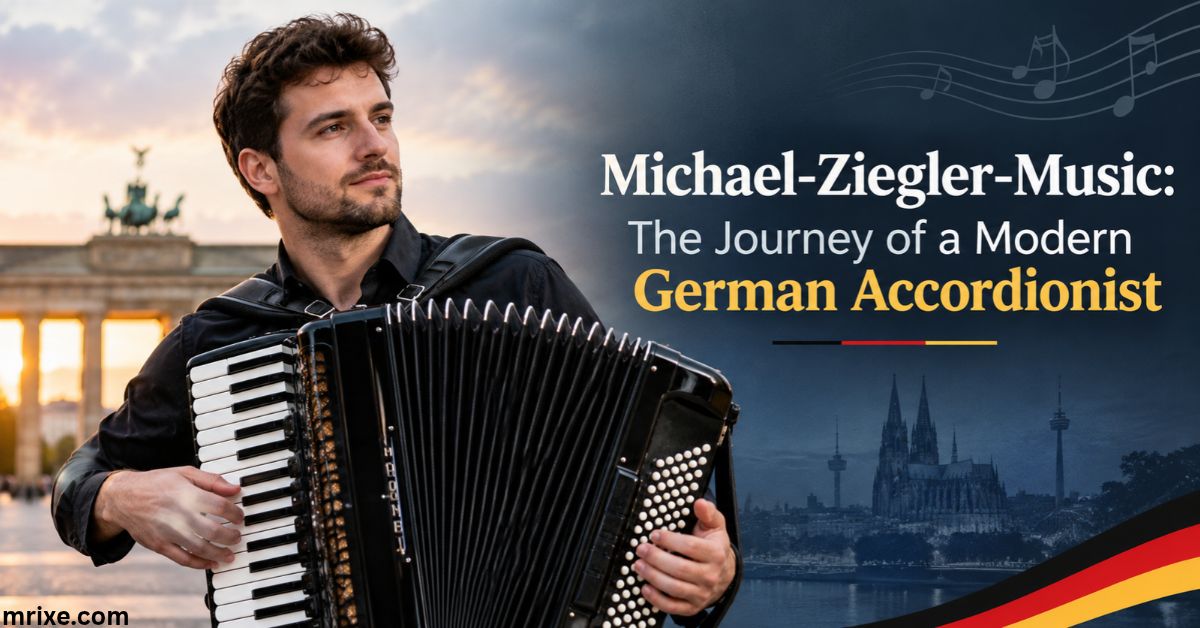
Picture a church in Germany on a spring evening. One musician sits alone with an accordion. No band, no backing track. Just bellows, breath, and a room that slowly goes quiet.
That scene sums up the world of Michael Ziegler. Fans and search engines often gather his work under one phrase: Michael-Ziegler-Music. Behind that phrase stands a young German accordionist, conductor, teacher, and composer who performs as Ziggi Accordion.
This guide walks through his training, his quartet, his competition results, his solo sound, and his first album. You’ll also find tables, case studies, and quick lists along the way.
Michael Ziegler at a Glance
Start with the essentials. The table below gives you the big picture in seconds.
| Topic | Key detail |
|---|---|
| Full name | Michael Ziegler |
| Stage name | Ziggi Accordion |
| Main instrument | Accordion |
| Roles | Professional accordionist, educator, conductor, and composer |
| Concert experience | More than 120 concerts |
| Debut album | Zeitlos (German for “timeless”) |
| Album size | 13 songs, mostly made with a loop station |
| Quartet | Musica in Fiore |
| Training | Hohner-Konservatorium Trossingen and the Hochschule für Künste Bremen |
| Musical label | Minimal music with a pop and classical mix |
Many people share the name Michael Ziegler. This article covers only the accordionist who releases music as Ziggi Accordion.
Who Is Michael Ziegler, the Accordionist Behind Ziggi Accordion?
Michael Ziegler is a German musician who treats the accordion as a modern instrument. He doesn’t see it as a museum piece. He says the accordion belongs in the present, not in the past.
The stage name Ziggi Accordion works as his artist brand. Under that name he publishes music that crosses genres, and in his compositions the accordion carries the solo melody. That detail matters. In many bands the accordion sits in the background. Here it leads.
He describes himself with four titles at once. He’s a professional accordionist, teacher, conductor, and composer. That mix explains his career. He plays on stage, writes music, leads orchestras, and teaches students.
What Makes His Profile Different?
Most accordionists choose one lane. Some stay classical. Others play folk or pop. Ziegler blends several. His concerts combine classical virtuosity, reworked pop songs, and original pieces.
His own words draw a clear line. He says his show is neither a classical accordion recital nor an ordinary pop cover program. That honest description helps new listeners know what to expect.
Early Years and Musical Training
Every strong performer has a training story. His runs through two well-known German music schools.
School Years and the Move to Trossingen
Ziegler finished school in 2018 at the Carl-Friedrich-Gauß-Gymnasium in Hockenheim. After that he began formal music training at the Hohner-Konservatorium in Trossingen.
Trossingen is a small town in Baden-Württemberg. It has a famous link to the harmonica and accordion trade. Musicians who study there work in a place where the instrument has deep roots.
What He Studied
His course load went well beyond the accordion. Alongside accordion he studied piano and teaching methods. He also chose conducting as his main subject with Stefan Hippe, a federal conductor in the German accordion scene.
Here’s why that matters. A player who also conducts thinks about the whole sound of a piece. A player who studies methods knows how to explain hard ideas. Both skills show up in his later work.
Early Stage Experience
He gained stage time long before his solo project took shape. During his conservatory years he played in the seminar orchestra and joined a quartet called 44Art, which gave concerts in Basel and Meran.
He also worked as a guest soloist. In 2018 he played the accordion solo in “Hamburg – Das Tor zur Welt” by Guido Rennert with the Musikverein Vaihingen/Enz under conductor Dominik M. Koch. Soon after, he took an accordion part with another orchestra led by the same conductor.
University Study in Bremen
The next step took him north. From 2020 to 2023 he studied classical accordion at the Hochschule für Künste in Bremen.
He is also linked to the class of Eric Dann at the Hohner-Konservatorium. Regional press listed him in Dann’s class when it reported his 2024 competition result.
Training Timeline
| Year | Milestone |
|---|---|
| 2018 | Finished school in Hockenheim; began studies at the Hohner-Konservatorium |
| 2018 | Played a solo accordion part with a wind orchestra |
| 2018–2020 | Played in the seminar orchestra and the quartet 44Art |
| 2020–2023 | Studied classical accordion in Bremen |
| 2024 | Won top competition placements with Musica in Fiore |
| 2026 | Released the album Zeitlos |
From Traditional Accordion to a Modern Sound
The accordion has a mixed image. Some people picture folk festivals. Others think of tango. Ziegler asks a fresh question about pop music. He wanted to know how pop sounds on an instrument that seems to come from another world.
His answer grew into his current style. It keeps the technical depth of classical training. Then it adds loops, space, and rhythm.
The Role of the Loop Station
A loop station records a short phrase and plays it back on repeat. The player then adds new layers on top. One accordion can sound like a small ensemble.
He uses this tool with care. His concerts build layer by layer and loop by loop, though he also plays some pieces with no loops, using only air, bellows, and breath.
That choice keeps the technology from taking over. The loops serve the music. They don’t replace the player.
Free-Bass Versus Standard-Bass Accordions
Many listeners never learn this difference, so a quick guide helps.
- Standard-bass (Stradella) accordion: The left hand plays preset bass notes and chords with buttons.
- Free-bass accordion (also called converter): The left hand plays single notes across a wide range, much like a piano’s left hand.
- Why it matters: Free-bass models let players perform classical works written for other instruments.
Classical conservatory programs in Germany commonly use free-bass instruments. That fits the repertoire in his quartet, which arranges string quartet music for accordions.
What Kind of Music Does Michael Ziegler Play?
Short answer: minimal music, pop reworkings, classical showpieces, and original works. Now the longer answer.
His Own Label for the Style
He describes his approach with a neat phrase. He calls it “Minimal Music mit maximaler Wirkung,” meaning minimal music with maximum impact. The idea is simple. Use fewer elements and make each one count.
Repertoire Categories
| Category | What it includes | Example |
|---|---|---|
| Virtuoso classics | Technically demanding concert pieces | “Asturias” |
| Pop reinterpretations | Familiar songs reshaped for accordion | Arrangements such as “Hit the Road Jack” in D minor at medium difficulty |
| Original works | Pieces he composed himself | “Home Again,” “Memories,” and “Zeitlos Rhapsodie” |
| Sacred and reflective programs | Concerts built around a theme | A solo church concert titled “Music for the Passion” |
His repertoire also stretches into jazz and popular music. He presents himself as both a virtuoso and a teacher.
The Emotional Center
Ziegler talks about feeling more than technique. In an interview he said the accordion lets him express emotions and take the audience on a journey that briefly lets worries fade.
That goal shapes the pacing of his shows. Quiet moments matter as much as loud ones.
Ziggi Accordion and the Michael-Ziegler-Music Project
Think of Ziggi Accordion as the solo brand and Michael-Ziegler-Music as the wider body of work. It covers concerts, recordings, arrangements, workshops, and booking.
What the Project Includes
His website is organized into clear sections:
- About: His story and vision
- Music and album: Recordings, including Zeitlos
- Sheet music: Arrangements for other players
- Live and dates: Concert listings
- Booking: Requests for concerts and cooperation
- Press kit: Material for organizers and media
This structure shows a working professional model. A fan can listen. A student can buy notes. An organizer can book a show.
His Stated Goal
He speaks openly about his aim. He wants to make a living from playing, stage work, and audience connection, and he calls music his path rather than a hobby.
That clarity helps explain his output. He records, teaches, conducts, and tours in parallel.
Michael Ziegler and His Original Music
Original compositions turn a performer into an artist. Ziegler writes his own pieces alongside his arrangements.
Named Compositions
Three titles stand out: “Home Again,” “Memories,” and “Zeitlos Rhapsodie.” The names suggest reflection and a sense of time. That matches the mood of his album title.
How the Accordion Leads
In his compositions the accordion plays the main melody. Many pop tracks give that job to a voice or guitar. Here the bellows carry the tune.
Listeners who enjoy film scores or neoclassical piano will find familiar ground. Slow builds, layered patterns, and warm harmonies define the sound.
The Album Zeitlos: A Statement Piece
An album marks a turning point for any musician. For Ziegler that moment came in 2026.
Release Facts
| Detail | Fact |
|---|---|
| Title | Zeitlos |
| Release date | April 19, 2026 |
| Track count | 13 songs |
| Production approach | Mostly built with a loop station |
| Stated purpose | Show the accordion in a modern light |
The Bigger Message
He frames the album as a claim about the instrument itself. He says the accordion doesn’t belong in a museum and belongs in the present.
He also ties the release to a wider event. In 2026 the accordion was named Instrument of the Year in Germany. The country has a tradition of spotlighting one instrument per year, so the timing gave his album extra context.
Who Will Enjoy It
Zeitlos suits several kinds of listeners:
- Fans of atmospheric instrumental music
- Accordion students who want fresh ideas
- Listeners who like minimal, rhythm-based structures
- Anyone curious about how loops change an acoustic instrument
Musica in Fiore: The Accordion Quartet
If you want proof of his skill, look at his quartet. Musica in Fiore ranks among the best-documented parts of his career.
Who Plays in the Quartet
The lineup features Michael Ziegler on first voice, Juliana Kraus on second voice, Nils Aebersold on third voice, and Karla Gvozden-Rizvic on bass. All four are soloists as well, and all studied at the Hohner-Konservatorium.
What the Name Means
The Italian name translates roughly as “music in bloom.” Aebersold explained the idea at a Trossingen concert, saying the group presents a colorful bouquet of music.
The Signature Move
Here’s what sets the group apart. They play string quartet music on accordions. One highlight was two movements of Shostakovich’s String Quartet No. 8, a piece written for two violins, a viola, and a cello.
That swap sounds risky. Accordions have a very different tone from strings. Yet the group turns the difference into a strength. The bellows can shape long phrases much like a bow.
The same concert included a fresh arrangement of a virtuoso piece. Their new setting of Zolotaryov’s “Rondo Capriccioso” drew a strong reaction from the audience.
Touring and Concerts
The quartet has traveled to Bozen, Brixen, Prague, and Heidelberg. Their programs run from old masters to modern accordion composers.
In 2024 they opened a gala concert at the Asamsaal in Ettlingen, where the program mixed original music, jazz, pop, and modern works.
International Competitions and Performance Results
Competition results give a fair, outside measure. Judges score players against strict standards. Here are the results from 2024.
Results Table
| Event | Place and date | Result |
|---|---|---|
| Akkordeon Musik Preis | Ettlingen, May 2024 | Musica in Fiore placed first in professional chamber music with 46 points |
| International Accordion Festival | Prague, October 24–27, 2024 | First prize in chamber music with 24.63 out of 25 points |
| Trophée Mondial | Montargis, France, November 25–30, 2024 | Quartet took second prize in chamber music; Ziegler won third prize in the Senior Virtuoso category |
Case Study: The Ettlingen Win
The Akkordeon Musik Preis belongs to the German Harmonica Association. It’s the federation’s youth competition and takes place every three years.
In the 2024 chamber category the margin was tight. The quartet scored 46 points, and Duo Vivo followed with 45. One point separated first from second. That shows how strong the field was.
Case Study: The Prague Festival
Prague added an international test. The quartet performed with a guest drummer, Arman Rizvic, and took first prize with a near-perfect score.
A score of 24.63 out of 25 leaves almost no room for error. It reflects tight ensemble work and careful preparation.
Case Study: The Trophée Mondial
The Trophée Mondial is a big name in accordion circles. Many call it the unofficial world championship for accordionists.
Ziegler earned a personal medal there. He took third place as a soloist in the Senior Virtuoso class in Eric Dann’s studio. His quartet added a second-place finish. Two podium results in one weekend show range in both solo and group play.
What These Results Tell You
- He performs well in solo and ensemble settings.
- His group won in two countries within a single year.
- His competition record supports his move into original work.
Live Concerts and Touring
A recording captures a moment. A live show creates one. Ziegler treats the concert as the heart of his work.
The Scale of His Live Work
He has played more than 120 concerts, from small stages to special concert formats. That number gives a sense of steady stage life.
He describes what he loves most. He enjoys the moment when a room goes quiet, a rhythm starts, and people begin to smile.
Case Study: The Hockenheim Church Concert
One documented show took place on March 16, 2024. It was a solo concert at the Protestant town church in Hockenheim under the motto “Music for the Passion.”
Church concerts suit his style. The rooms have long natural echo. Quiet passages ring clearly. Soft accordion tones fill the space without a microphone.
A Look at His Spring 2025 Calendar
His calendar showed a busy stretch in spring 2025. Entries included a concert hall show in Trossingen with Musica in Fiore, a festival slot titled “Akkordeon Grenzenlos,” a solo tour in the Czech Republic, and church concerts where he also conducted.
| Type of appearance | Role |
|---|---|
| Concert hall show in Trossingen | Quartet member |
| “Akkordeon Grenzenlos” in Trossingen | Solo and with the quartet |
| Tour in the Czech Republic | Solo performer |
| Concert in Möhringen | Conductor of a leisure orchestra |
| Church concert in Maichingen | Conductor and quartet member |
This mix shows his real weekly life. He switches between soloist, chamber player, and conductor.
Teaching and Musical Education
Many musicians treat teaching as a side job. Ziegler treats it as part of the art.
His Teaching Philosophy
He argues that being a fine player doesn’t automatically make someone a fine teacher, and he wants to prove that both can go together. He adds that lessons inspire him, since he learns from his students too.
He also enjoys progress over time. He likes to watch students improve week after week, on a musical and a personal level.
Conducting Work
His conducting training paid off in practice. After his studies he began conducting accordion orchestras and continued with the Bremen Accordion Ensemble. His 2025 calendar also listed him with orchestras in Möhringen and Maichingen.
Workshops for Other Musicians
He runs workshops that show other musicians how modern technology can transform the accordion. Topics likely include loop setups and layered performance, since those define his own show.
Sheet Music for Players
He sells arrangements with difficulty levels, such as a medium-level arrangement of “Hit the Road Jack” in D minor.
Here’s how to pick the right level:
- Beginner: Look for simple keys and slow tempos.
- Intermediate: Try medium-rated pop arrangements.
- Advanced: Explore classical showpieces like “Asturias.”
Why the Accordion Matters in His Music
Why choose the accordion at all? Ziegler gives a personal answer.
He says the accordion breathes and lives, and that it forces a player to be honest. That idea shapes his whole style.
The Accordion as a Breathing Instrument
A piano hits a note and lets it fade. An accordion keeps shaping sound as long as the bellows move. The player controls swell, fade, and silence with one arm.
That control fits minimal music. Small changes in pressure create big changes in mood.
A Whole Orchestra in Two Hands
The accordion also covers many roles at once. It plays melody and chords together. With a loop station it can add rhythm and bass layers.
- Right hand: Melody and harmony
- Left hand: Bass and chords
- Bellows: Expression and dynamics
- Loop station: Extra layers on demand
Changing Old Ideas
Many people link the accordion with tradition alone. Ziegler shows a wider range. His concerts prove one instrument can hold classical, pop, and cinematic moods.
Michael Ziegler Musical Style Explained
Style comes from choices. Here are the main ones behind his sound.
Five Traits of His Sound
- Layering: Loops build patterns slowly.
- Space: Reverb rooms create a cinematic feel.
- Restraint: Fewer notes carry more weight.
- Rhythm: Steady pulses drive many pieces.
- Breath: Some works use only air and bellows.
Where Minimal Music Comes From
Minimal music grew from a 20th-century movement built on repeating patterns and slow change. Ziegler applies that idea to the accordion. His own phrase, “minimal music with maximum impact,” sums up the link.
Mood Range
His shows move between moods. Some pieces drive forward. Others turn quiet and inward. He mixes energy and calm on purpose. A concert should feel like a journey from energy to stillness.
Michael Ziegler’s Online Presence
Fans can follow his work across several platforms under the name Ziggi Accordion.
| Platform | What you’ll find |
|---|---|
| Official website | Biography, album details, sheet music, dates, booking |
| YouTube | Live clips, videos, and teaching content |
| Short performance clips and updates | |
| TikTok | Short-form videos |
| News and concert announcements |
How to Contact and Book Him
His website has a dedicated booking page for concerts and cooperation. It also has a press section for organizers and media.
Tips for organizers:
- Share the venue type so he can plan a loop or a no-loop set.
- Mention the audience to help shape the repertoire.
- Ask about workshops if you run a music school or club.
Is Michael Ziegler a Composer?
Yes. Composer is one of his four professional titles.
His works include “Home Again,” “Memories,” and “Zeitlos Rhapsodie.” He also writes arrangements. Those range from pop songs for players to quartet settings of classical pieces.
The difference matters:
- Composition: A new piece written from scratch.
- Arrangement: An existing piece rewritten for new instruments.
He does both. That makes his catalog richer than a cover artist’s list.
What Makes Michael Ziegler Interesting to Music Fans?
Here’s a quick summary of why people follow his work.
Reasons to Listen
- Proven results: Wins in Ettlingen and Prague, plus a podium finish in France.
- A fresh sound: Loops, space, and rhythm on a classic instrument.
- Range: Solo, quartet, orchestra, and classroom.
- Honest vision: Clear goals about living from music.
- Useful output: Sheet music and workshops for other players.
Who Should Pay Attention
| If you are… | You’ll enjoy… |
|---|---|
| An accordion student | Sheet music, workshops, and technique ideas |
| A fan of instrumental music | The album Zeitlos |
| A concert organizer | Solo shows and quartet programs |
| A classical music lover | Musica in Fiore’s string quartet arrangements |
| A pop listener | Fresh takes on familiar songs |
Frequently Asked Questions About Michael Ziegler
Who is Michael Ziegler?
Michael Ziegler is a German accordionist, conductor, teacher, and composer. He performs under the name Ziggi Accordion. He trained at the Hohner-Konservatorium in Trossingen and at the Hochschule für Künste in Bremen.
What instrument does Michael Ziegler play?
He plays the accordion. Live he also uses a loop station to build layered sound. Some pieces use no loops at all.
What is Ziggi Accordion?
Ziggi Accordion is his artist name. It covers his solo concerts, recordings, arrangements, and workshops. It’s also the name attached to the Zeitlos album.
Does Michael Ziegler write his own music?
Yes. His original works include “Home Again,” “Memories,” and “Zeitlos Rhapsodie.” He also arranges pop songs and classical pieces.
Is Michael Ziegler part of a musical group?
Yes. He plays first voice in the accordion quartet Musica in Fiore. He also conducts accordion orchestras, and he performs solo.
What awards has he won?
With Musica in Fiore he won first place at the 2024 Akkordeon Musik Preis in Ettlingen and first prize at the Prague festival. At the Trophée Mondial he took third place as a soloist in the Senior Virtuoso category.
Where can I hear his music?
Search for Ziggi Accordion on YouTube and the major streaming platforms. His official website also gathers his album and concert news in one place.
Final Thoughts on Michael Ziegler and His Accordion Journey
Michael Ziegler shows how far one instrument can travel. He began with formal training in Trossingen and Bremen. He then built a quartet that won prizes in Germany and abroad. Today he shapes a solo sound around loops, space, and breath.
Michael-Ziegler-Music stands for more than one album or one stage. It covers concerts, conducting, teaching, sheet music, and original works. Each part supports the others.
His message stays consistent. The accordion belongs in the present. With the release of Zeitlos in 2026, he made that case in his own voice.
Ready to hear it for yourself? Watch a live clip and check his concert dates. A quiet room, one accordion, and a slow build of sound can change how you think about the instrument.

Nathan Cooper is a humor writer who enjoys creating clever puns, witty jokes, and lighthearted content that brings smiles to readers. He loves sharing fresh, family friendly humor that’s fun, engaging, and easy to enjoy.