

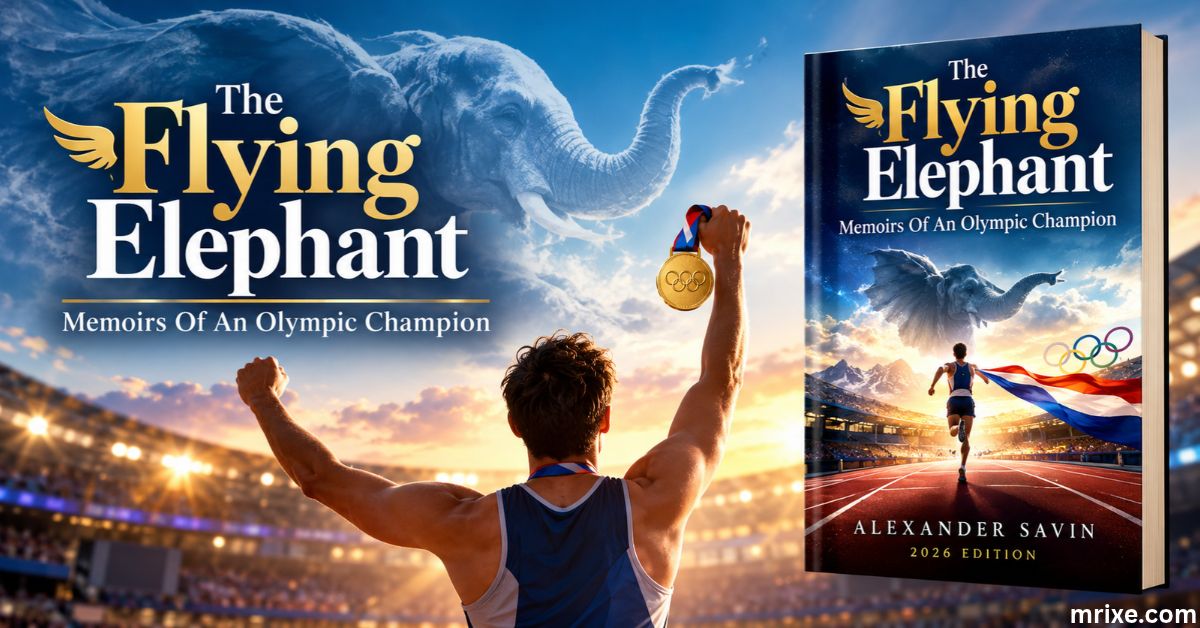
Some sports books list results. Others take you inside the locker room. The Flying Elephant: Memoirs of an Olympic Champion aims for the second kind, and it comes from a man who stood on two Olympic podiums.
Alexander Savin won silver at Montreal in 1976. Four years later, he won gold at home in Moscow. This guide covers what the book offers and who wrote it. It also covers the career behind it and what to check before you buy.
Quick answer: The Flying Elephant: Memoirs of an Olympic Champion is a 514-page English Kindle memoir by Soviet volleyball star Alexander Savin. Amazon lists it as published on October 26, 2025.
What Is The Flying Elephant: Memoirs of an Olympic Champion About?
The book tells the story of a volleyball career at the top of world sport. According to the Amazon description, it covers the golden age of Soviet volleyball and Savin’s later life in coaching. It promises stories from CSKA Moscow and the USSR national team. It also promises portraits of volleyball figures that history has half-forgotten.
Think of it as two books in one. The first half of the story is a player’s rise. The second is a coach’s reflection on what he learned.
Who Is Alexander Savin?
Aleksandr Borisovich Savin was born on July 1, 1957, in Taganrog, Russia. He stands 200 cm (6 ft 7 in) tall and played as a middle blocker. He wore number 3 and played for the Soviet national team from 1975 to 1986, according to Wikipedia.
The sport recognized him formally in 2010. The International Volleyball Hall of Fame in Holyoke, Massachusetts, inducted him on October 22, 2010.
Quick profile
| Detail | Fact |
|---|---|
| Full name | Aleksandr Borisovich Savin |
| Born | July 1, 1957, Taganrog |
| Height | 200 cm (6 ft 7 in) |
| Position | Middle blocker |
| National team years | 1975–1986 |
| Olympic medals | Silver (1976), Gold (1980) |
| Hall of Fame | International Volleyball Hall of Fame, 2010 |
What Does the Kindle Edition Include?
Here’s what the the flying elephant memoirs of an olympic champion kindle edition alexander savin listing actually shows. It’s an English-language ebook of 514 pages. The file size is 68.8 MB, which hints at the heavy photo content. The ASIN is B0FXVDWW16.
Who Worked on the English Edition?
Several people share credit. The Amazon listing names these contributors:
- Alexander Savin as author
- Andrei Savine as editor and translator
- Julia Savine as editor
- Peter Murphy for the introduction
- Alfredo Cabero as translator
The listing adds that two more contributors appear beyond those shown at the top. Open the full page to see every name.
What Does the Listing Promise Inside?
The description highlights five features:
- Insider stories from CSKA Moscow and the USSR national team
- Portraits of forgotten volleyball legends
- Behind-the-scenes looks at Olympic competition and international play
- A coaching philosophy for young players
- More than 240 rare photographs from family collections and public archives
That last point matters. A memoir with 240 photos spanning five decades works almost like a visual archive. Readers who love history will linger over those pages.
Alexander Savin’s Early Life and Rise in Volleyball
Great careers rarely start in big cities. Savin’s started in a smaller one.
How Did Savin Begin Playing Volleyball?
Savin was born in Taganrog but moved with his parents to Obninsk, a town in Kaluga Oblast. He studied at high school No. 6 there. As a student in Obninsk, he started playing volleyball. He played club volleyball in 1967 for Obninsk Youth. That club was later renamed a sports school, and in 2004 the school took Savin’s name.
His first coach was Vladimir Pitanov (1946–2016).
Consider what that means. A town sports school now carries his name. Few athletes get that kind of local legacy.
How Fast Did He Reach the National Team?
Quickly. In 1975, Savin won the European Junior Championship with the Under-20 team in West Germany. That same year, he joined the senior Soviet side. He then won the senior European title in Yugoslavia in 1975.
By age 19, he was on the Olympic roster for Montreal.
What Were Savin’s Major Volleyball Achievements?
His trophy list reads like a checklist of every major event of his time. The table below gathers the medals confirmed by Wikipedia and Olympedia.
| Competition | Year | Result |
|---|---|---|
| Olympic Games (Montreal) | 1976 | Silver |
| Olympic Games (Moscow) | 1980 | Gold |
| World Championship | 1978 | Gold |
| World Championship | 1982 | Gold |
| World Championship | 1986 | Silver |
| World Cup | 1977 | Gold |
| World Cup | 1981 | Gold |
| European Championship | 1975, 1977, 1979, 1981, 1983, 1985 | Gold (six titles) |
| Friendship Games (Havana) | 1984 | Gold |
| Goodwill Games (Moscow) | 1986 | Gold |
| European Junior Championship | 1975 | Gold |
Count the golds. He collected six European titles in eleven years. He also took two World Cup wins and two world championships.
What Honors Did He Receive?
The state also recognized him. He earned the title Honored Master of Sports of the USSR in 1976. He received the Order of the Badge of Honour in 1980. In 1985, he got the Order of Friendship of Peoples.
What Role Did Savin Play for the Soviet Team?
Savin played middle blocker. That position sits at the net and controls the most dangerous space on court. A good middle blocker stops attacks before they land. He also attacks quick sets.
Why Does the Middle Blocker Role Matter?
Middle blockers touch the ball less than setters or outside hitters. Yet their influence is huge. A single well-timed block can swing a set. Savin’s height gave him reach, but timing made him special.
What Was the Savin-to-Zaytsev Connection?
Volleyball historian Mark Lebedew has written about the Savin and Zaytsev combination. He calls it the most famous pairing in men’s volleyball in the late 1970s. Vyacheslav Zaytsev captained the USSR for years. He won gold in 1980 and silver in 1976 and 1988, per VolleyHall.
Savin also played under coach Yuri Chesnokov, a Hall of Fame coach. The Soviet team under Chesnokov entered 1980 as heavy favorites.
Why Do the 1976 and 1980 Olympics Matter in Savin’s Story?
These two tournaments frame the entire memoir. One ended in heartbreak. The other ended in gold.
Case Study: What Happened at the 1976 Olympics in Montreal?
The men’s volleyball tournament ran from July 18 to 30, 1976. Matches took place at the Montreal Forum and Paul Sauvé Arena. Savin played all five matches for the Soviet team.
The final went to Poland. Poland beat the USSR 3–2, with set scores of 11–15, 15–13, 12–15, 19–17 and 15–7. The Soviets took the first and third sets. Poland won the fourth in extra points and then took the fifth by a wide margin.
What the case teaches:
- Two sets from victory can still end in defeat.
- Even great teams can lose a deciding set 15–7.
- The Soviet response was to return stronger, as the next section shows.
The Hall of Fame bio says the loss strengthened Soviet determination. That kind of resilience is a theme you’ll likely find in any memoir by an athlete who lost a final.
Case Study: What Made Savin an Olympic Champion in Moscow in 1980?
Four years later, the Soviets hosted the Games. Savin played all six matches. According to the Hall of Fame profile, the path looked like this:
- Opener: a 3–1 win over Czechoslovakia
- Pool play: shutouts against Italy, Bulgaria and Cuba
- Semifinal: a sweep of Romania
- Final: a 3–1 win over Bulgaria
That’s six matches and only one dropped set in the games described. It’s about as dominant as a home Olympics can get.
Lessons from the 1980 run:
- Preparation beats pressure when a team trains for it.
- Home crowds help but only if the team is already ready.
- Redemption stories hit hardest after a close loss.
What Did Come After 1980?
Savin’s international career ran until 1986. In that stretch, he added the 1981 World Cup, the 1982 world title and more European crowns. The Soviet Union boycotted the 1984 Los Angeles Games. Savin still won gold at the 1984 Friendship Games in Havana, which many Eastern Bloc nations attended instead.
What Was Soviet Volleyball Like During Alexander Savin’s Era?
Soviet volleyball dominated men’s play early on. The sport made its Olympic debut in 1964 in Tokyo. According to the Hall of Fame, the USSR won the first two Olympic titles, in 1964 and 1968.
Then came a dip. In 1972, the Soviets went undefeated in pool play at Munich but lost the semifinal to East Germany. They took bronze against Bulgaria. A new generation, including Savin, rebuilt the team into a champion again.
Soviet men’s Olympic volleyball timeline
| Year | Host | Soviet result |
|---|---|---|
| 1964 | Tokyo | Gold |
| 1968 | Mexico City | Gold |
| 1972 | Munich | Bronze |
| 1976 | Montreal | Silver |
| 1980 | Moscow | Gold |
How Did the Soviet Sports System Shape Elite Volleyball?
The Soviet system built athletes through organized clubs and sports schools. Savin’s own path shows this. He started at a youth sports club in Obninsk. Later he played for CSKA Moscow, the army’s sports club, per the Amazon description.
The state also awarded titles and orders to top athletes. Savin’s three honors from 1976 to 1985 show how formal that recognition was.
Did the 1980 Boycott Affect the Moscow Games?
Yes. Many Western nations boycotted the 1980 Moscow Olympics. That fact matters for context. Italy and Cuba still competed in the men’s volleyball tournament, and Savin’s team beat them. Still, historians often note the boycott when discussing the 1980 field. A good memoir lets the athlete tell his own side of that story.
What Can Readers Learn From The Flying Elephant Memoirs of an Olympic Champion?
A strong sports memoir teaches beyond sport. According to the Amazon description, this one offers insider stories, coaching views and rare photos. Here’s what readers can reasonably expect.
Life of an Elite Athlete: What Can You Find in the Book?
Based on the listing, you can expect:
- Club life: stories from CSKA Moscow
- National team life: insights from the USSR squad
- Competition detail: behind-the-scenes views of Olympic and international events
- People: profiles of volleyball figures who shaped the game
Memoirs always reflect one person’s memory. That’s not a flaw. It’s the point. You read them for perspective, not for a neutral record.
What Coaching Lessons Does the Book Offer?
The listing says the book shares a coaching philosophy for developing young players. That makes it useful beyond fandom. Coaches and parents of young athletes may find practical ideas there.
Savin’s own history supports this angle. A town sports school bears his name, and he stayed connected to developing players after retiring from competition.
What About the “Flying Elephant” Nickname?
The title is a nickname, but the Amazon listing doesn’t explain it. One secondary review site says Italian press coined it, citing La Gazzetta dello Sport. I couldn’t confirm that in a primary source. Treat it as unverified, and read the book for Savin’s own account.
How Does the Kindle Edition Compare With a Print Edition?
Right now, the only confirmed format is Kindle. I found no verified print listing, so don’t assume a paperback exists.
Kindle edition at a glance
| Feature | Detail |
|---|---|
| Format | Kindle ebook |
| Language | English |
| Length | 514 pages |
| Publication date | October 26, 2025 |
| File size | 68.8 MB |
| ASIN | B0FXVDWW16 |
What Are the Kindle Advantages?
A 514-page book with 240+ photos is heavy in print. On Kindle, you carry it anywhere. You can also adjust text size, highlight passages and take notes. Photos can be zoomed in on a tablet.
What Are the Kindle Drawbacks?
The 68.8 MB file is large. Photo-heavy ebooks look best on color screens like tablets or phones. A basic e-ink Kindle shows photos in grayscale. Check your device before buying if images matter to you.
What Should You Check Before Buying The Flying Elephant?
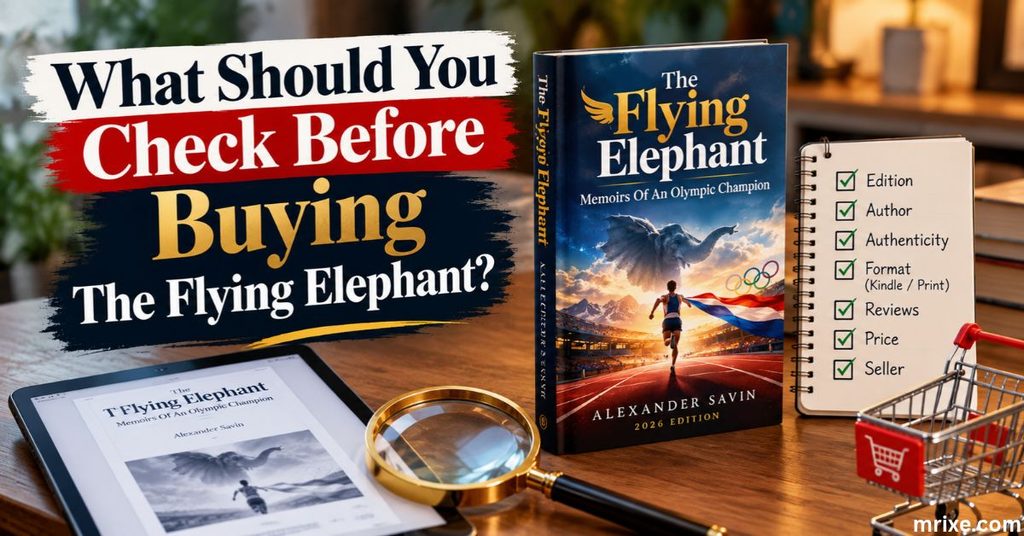
A short checklist saves frustration. Look at these items on the Amazon page for the flying elephant memoirs of an olympic champion kindle edition alexander savin:
- Title: search the full title to avoid look-alike pages
- Author: Alexander Savin
- ASIN: B0FXVDWW16
- Contributors: editors, translators and introduction author
- Price: it changes by store and date
- Kindle Unlimited: some secondary sites report it, but eligibility varies by country
How Can You Verify the Author, Publisher, and Edition?
Open the product page and scroll to Product details. Match the ASIN. Then read the contributor list. If those match, you’re on the right page.
Be careful with blog posts that copy the title many times. Several sites repeat the same keyword-stuffed text with no new information. The Amazon listing is your best source.
Why Check the Preview and Reviews?
Use the Look Inside or sample feature. It shows the writing style and how photos display on your device. Reviews help too. Read recent ones and look for comments about translation quality and layout.
Who Should Read The Flying Elephant: Memoirs of an Olympic Champion?
This book suits specific readers best. Here’s a quick guide.
| Reader type | Why it fits |
|---|---|
| Volleyball fans | First-person view of a Hall of Fame career |
| Coaches | Coaching philosophy section |
| Olympic history readers | Covers Montreal 1976 and Moscow 1980 |
| Soviet sports history readers | Club and national team life from inside |
| Photo and archive lovers | 240+ rare photographs |
Is It a Good Choice for Volleyball Fans?
Absolutely. Savin’s résumé includes two Olympic medals, two world championship golds and six European titles. Few players saw as much. A volleyball fan gets stories from the sport’s strongest Soviet era.
Could It Interest Readers Outside Volleyball?
Yes. Anyone curious about Cold War sport will find context here. Memoirs add the human layer that medal tables skip.
Why Does the Book Still Have Value Today?
Three reasons stand out:
- Primary perspective. It’s written by a participant, not a bystander.
- Rare imagery. Over 240 photos span five decades.
- Practical lessons. Coaching ideas apply to modern youth sport.
What Makes Savin’s Olympic Journey Historically Interesting?
His career spans an unusual arc. He lost a final in 1976. He won a home Olympics in 1980. He then missed the 1984 Olympics because of the boycott yet kept winning for two more years. Few athletes lived through that mix of triumph and politics.
Is The Flying Elephant Kindle Edition Worth Reading?
For the right reader, yes. The subject is strong and the book is long. The edition is also well credited.
Pros and cons
| Pros | Cons |
|---|---|
| Written by a Hall of Fame player | 514 pages demands time |
| 240+ photos | Large file size |
| Coaching insights included | Only Kindle format confirmed |
| Covers two Olympic cycles | Memoir reflects one person’s view |
What Should You Expect Before Starting?
Expect a long, personal read. Plan to read in sessions. Use highlights for names and dates. Keep a browser tab open for Olympedia so you can check results as you go.
Quick Facts About Alexander Savin and the Memoir
- Book title: The Flying Elephant: Memoirs of an Olympic Champion
- Author: Alexander Savin
- Format: Kindle ebook, English
- Length: 514 pages
- Published: October 26, 2025
- ASIN: B0FXVDWW16
- Photos: 240+
- Born: July 1, 1957, Taganrog
- Position: Middle blocker
- Height: 200 cm
- Olympic medals: Silver 1976, Gold 1980
- 1976 final: lost 3–2 to Poland
- 1980 final: beat Bulgaria 3–1
- Hall of Fame: inducted October 22, 2010
- First coach: Vladimir Pitanov
- Club: CSKA Moscow (per Amazon description)
Multiple-Choice Questions
Test what you’ve learned. Answers follow each question.
What sport did Alexander Savin compete in?
- A) Basketball
- B) Volleyball
- C) Handball
- D) Water polo
Answer: B) Volleyball.
Which medal did Savin win at the 1976 Montreal Olympics?
- A) Gold
- B) Bronze
- C) Silver
- D) None
Answer: C) Silver. Poland beat the USSR 3–2 in the final.
Which Olympic Games brought Savin his gold medal?
- A) Montreal 1976
- B) Moscow 1980
- C) Los Angeles 1984
- D) Seoul 1988
Answer: B) Moscow 1980.
Which club does the Amazon description connect to Savin’s career?
- A) Dynamo Kyiv
- B) Lokomotiv Novosibirsk
- C) CSKA Moscow
- D) Zenit Kazan
Answer: C) CSKA Moscow.
What position did Savin play?
- A) Setter
- B) Libero
- C) Middle blocker
- D) Opposite
Answer: C) Middle blocker.
What Is the Key Summary of The Flying Elephant Memoir?
The Flying Elephant: Memoirs of an Olympic Champion is a 514-page English Kindle memoir by Alexander Savin. Savin was a Soviet middle blocker who won Olympic silver in 1976 and gold in 1980. He also collected world, World Cup and European titles. The book promises CSKA Moscow stories, portraits of volleyball figures, coaching ideas and more than 240 photographs.
Before buying, confirm the ASIN, check the contributor list and test the sample on your device. Only the Kindle format is confirmed. If you love volleyball or Olympic history, this memoir is worth a look.

Nathan Cooper is a humor writer who enjoys creating clever puns, witty jokes, and lighthearted content that brings smiles to readers. He loves sharing fresh, family friendly humor that’s fun, engaging, and easy to enjoy.