
You type a website’s name into Google and get ten reviews that disagree with each other. One calls the site a gem. Another calls it filler. Who’s right?
That’s exactly what happens with pressvibepulse com. This guide cuts through the noise. You’ll get the facts that outside sources actually report, a clear checklist for judging any article, and a straight verdict on who should use the site and how.
Here’s the short version. The site is a broad, multi-topic web magazine. It runs on HTTPS and appears to be about three years old. It publishes across everything from tech to health. That mix isn’t automatically bad. It does mean you should check each article on its own merits.
Quick Facts About PressVibePulse Com at a Glance
Start with the basics. This table separates what third-party sources report from what you should confirm yourself.
| Detail | What reports say | How to confirm |
|---|---|---|
| Site type | Multi-category web magazine | Open the homepage |
| Menu categories | Health, Business, Travel, Technology, Finance, Fashion, Lifestyle | Check the top navigation |
| Domain registered | Reportedly August 23, 2023 | Run a lookup at ICANN Lookup |
| Approximate domain age | About 3 years and 2 months as of October 2026 | Calculate from the registration date |
| HTTPS | Enabled | Look for the padlock in your browser |
| Infrastructure | Cloudflare | Run a DNS or header lookup |
| Guest-post presence | The domain has appeared in a third-party guest-post marketplace | Search the site for sponsored labels |
| Reading cost | Described as free by several reviews | Test in a private browser window |
The category list comes from a Makerstations review. The registration, HTTPS, Cloudflare, and guest-post details come from a TycoonStory review. Treat these as reported facts. A two-minute check on your end makes them solid.
What Is PressVibePulse Com?
Think of pressvibepulse com as a general-interest online magazine. It doesn’t focus on one industry. Instead, it publishes on many everyday subjects in one place.
A Broad Web Magazine, Not a Single-Subject Newsroom
The site works like a general content library rather than a newsroom devoted to one subject, and it publishes plain-English guides across many industries and daily themes. Picture a big public library instead of a medical school library. You’ll find something on almost every topic. You won’t always find the deepest expert source on each one.
Broad sites like this tend to serve a certain kind of reader. They suit people who want a quick explanation of a term or trend. They work less well for people who need a final answer on something with real consequences.
Publisher vs. Newsroom: Why the Difference Matters
People often use “publishing” and “journalism” as if they mean the same thing. They don’t. One reviewer draws the line clearly: publishing distributes content, while journalism adds stronger expectations around verification, independence, attribution, and accountability.
Here’s a simple way to picture it:
- A publisher puts articles online.
- A newsroom investigates, verifies, corrects mistakes publicly, and names the people behind each story.
Both can be useful. You just shouldn’t hold them to the same standard. When you read pressvibepulse com, treat it as a publisher first. Then look for signs that it behaves like a newsroom on specific stories.
Not to Be Confused With PressPulse AI
A quick warning. Search results often mix this site with a different product. PressPulse AI is an AI-powered tool that connects experts with journalist requests and helps draft pitches (Tool Junction listing). It’s a public relations service. It has nothing to do with this magazine.
If you landed here looking for a PR tool, you want PressPulse AI. If you wanted the magazine, you’re in the right place.
What Can You Find on PressVibePulse Com?
The site’s menu spans seven main areas. Here’s what each one typically covers and how careful you should be with it.
| Category | Typical topics | Reader risk level |
|---|---|---|
| Technology | Gadgets, apps, digital tools | Low to medium |
| Business | Startups, marketing, work trends | Medium |
| Finance | Money tips, savings, markets | High |
| Health | Wellness, symptoms, nutrition | High |
| Travel | Destinations, planning tips | Low |
| Fashion | Style trends, seasonal looks | Low |
| Lifestyle | Home, habits, daily life | Low |
Low-Risk vs. High-Risk Topics
Not every mistake costs the same. A wrong guess about a hotel’s lobby won’t hurt you. A wrong claim about a medication or a tax deadline could.
Google uses a handy term for this. Its quality guidelines call high-stakes topics “Your Money or Your Life” subjects. These cover health, finances, and legal matters. They demand stronger proof of expertise. Google also explains its view of reliable content in its guide to creating helpful, reliable, people-first content.
Apply the same logic when you browse pressvibepulse com. Relax a little on travel and fashion. Tighten up on health and finance.
How PressVibePulse Com Works: Navigation, Layout, and Mobile Use
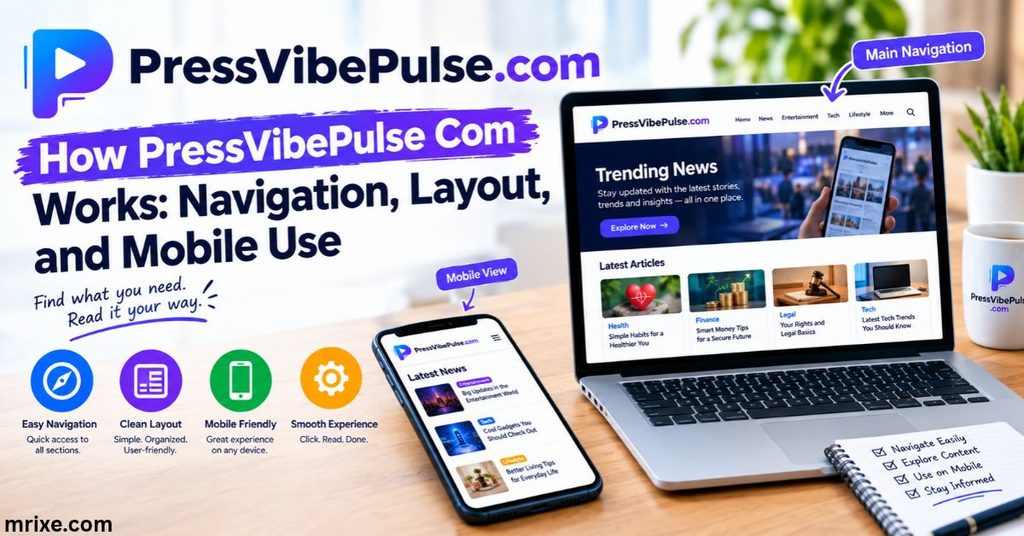
Understanding how the site works helps you use it faster. Here’s what the structure looks like from a reader’s seat.
Website Navigation and Categories
The site relies on a category menu. You pick a topic from the top navigation and land on a feed of related articles. That’s a standard magazine setup.
Category menus speed up discovery. As one review notes, a layout like this helps readers find content quickly. It doesn’t guarantee that each article is strong. As that same review points out, in any mixed-topic publication, the quality of a single article counts for more than the length of the menu.
How Readers Discover Articles
Most people won’t start at the homepage. They’ll arrive in one of three ways:
- Search engines. A reader searches a question and lands on a matching article.
- Category browsing. A reader picks a topic and scrolls the feed.
- Direct visits. A reader bookmarks the site and returns.
One review makes a useful point here. Search visibility can bring people to the site, but ranking alone doesn’t prove authority. A page can rank well and still be thin. Keep that in mind whenever Google hands you a result.
Content Format and Reading Experience
Reports describe the writing as plain and quick to read. That suits skimmers. Short explainers and guides are the typical format.
For you, this means two things. First, you can learn the basics fast. Second, you should expect summaries rather than deep investigations. Think of it as the appetizer menu. Don’t expect the full meal.
Mobile Browsing Experience
Several reviews say the site works on phones and tablets. That’s the baseline for any modern site. Still, you can test it in under a minute:
- Open an article on your phone.
- Check whether the text needs pinch-zooming.
- Count how many pop-ups or banners cover the content.
- Scroll to the bottom and see whether the page jumps around as it loads.
A smooth mobile page is a good sign. It says nothing about accuracy, though.
Is PressVibePulse Com Legit and Safe to Use?
This is the question most readers care about. Let’s split it in two. Legit asks whether the site is real and run by someone accountable. Safe asks whether visiting it puts your device or data at risk.
What Third-Party Reports Confirm
Reports agree on several points. The site is live. It uses HTTPS. It sits behind Cloudflare. It publishes across many topics. None of those details raises a red flag by itself.
Plenty of legitimate sites use Cloudflare. It’s a common service that speeds up pages and blocks some attacks. However, Cloudflare doesn’t vouch for the quality of what a site publishes. It only delivers the pages.
HTTPS and Basic Website Security
HTTPS means the connection between your browser and the site is encrypted. Nobody on the same Wi-Fi network can easily read what passes between you and the page. That’s good.
Here’s the catch. HTTPS doesn’t prove the content is true. Even scam sites can have the padlock. Treat it as the minimum requirement and not a trust badge.
For an extra layer of protection, run the address through Google’s Safe Browsing site status tool. It tells you whether Google has flagged a site for malware or phishing.
Domain Age and Ownership
The registration date matters. The domain was reportedly registered on August 23, 2023. By October 2026, that makes it roughly three years and two months old.
What does that tell you? Three years is long enough to rule out a throwaway scam page. It’s short compared with established outlets that have operated for decades. Age helps with history. As one review states, the age of the domain helps establish its history but doesn’t determine whether every article is trustworthy.
To check ownership yourself, use the ICANN lookup tool. Many owners hide personal details behind privacy services. That’s common and legal. It does mean you can’t easily see who runs the site. In that case, the site’s own About and Contact pages carry more weight.
Pages Every Trustworthy Publisher Should Have
A reliable publisher usually shows its work. Use this checklist when you visit the site:
| Page | Why it matters | What to look for |
|---|---|---|
| About | Shows who runs the site | Named team or company |
| Contact | Lets readers report errors | Working email or form |
| Editorial policy | Explains how content gets made | Fact-checking and sourcing rules |
| Corrections policy | Shows accountability | A way to flag mistakes |
| Privacy policy | Required for data collection | Clear cookie and tracking details |
| Terms of use | Sets site rules | Plain language |
| Advertising disclosure | Separates ads from content | Sponsored labels |
Each missing page lowers your confidence a notch. Several missing pages should make you cautious about important claims.
Guest Posts and Sponsored Content
Here’s a fact many readers miss. The domain has appeared in a third-party guest-post marketplace, but a listing there doesn’t mean every article is sponsored.
What does that mean for you? Some articles may come from outside contributors who paid for placement or supplied content for a link. That’s common across the web. Responsible sites label it clearly. The U.S. Federal Trade Commission, at ftc.gov, expects paid relationships to be disclosed.
When you read any article, scan for these signals:
- A label such as “Sponsored,” “Partner content,” or “Advertisement”
- Links that point to one business repeatedly
- Praise for a product with no downsides mentioned
- An author with no profile or history
Why Reviews of This Site Conflict
You’ll notice something odd when you search for reviews. They don’t agree. As one source puts it, competitor reviews disagree sharply about the site.
Here’s why. Many “review” pages exist to rank in search and place links. They often repeat the same claims without checking them. Some say the site publishes “researched, checked” pieces. Others make big promises about daily updates or country desks. Few offer proof.
So how should you handle these reviews? Look for pages that name specific details, such as dates, categories, and technical facts. Be skeptical of any review that only gushes or only trashes.
Is PressVibePulse Com Trustworthy? Five Signals to Check
Legit and trustworthy aren’t the same thing. A site can be real and still publish weak content. Use these five signals to judge the writing itself.
Author Expertise and Credentials
Ask one question first. Who wrote this? A named author with a relevant background beats an anonymous byline every time.
Pay attention to range. One review gives sound advice here: covering unrelated fields well takes real skill in each one, so judge the writer, the posting date, and the linked sources rather than the surface polish.
Here’s a quick test. If one author writes about heart health on Monday, crypto taxes on Tuesday, and skincare on Wednesday, ask how they gained that expertise. Generalists exist. Experts in everything are rare.
Sources and Citations
Good articles show where their facts come from. Look for links to:
- Primary sources like government sites, court documents, and original studies
- Named reports with a date and author
- Official data from agencies
Be wary of articles that cite other blogs in a circle. If Blog A cites Blog B and Blog B cites Blog A, nobody checked anything.
One review offers a useful benchmark. Strong publishers tie each figure to a named survey. Hold every article you read to that bar.
Editorial Transparency
Transparent sites explain how they work. They say who edits, how they fact-check, and how to report an error. Check for an editorial policy page. Then see whether the articles follow it.
If a site has no visible standards, you can’t hold it to any. That’s a risk for high-stakes topics.
Content Accuracy and Freshness
Dates matter more than most readers realize. A 2021 article about tax rules or app features might be outdated in 2026. Always check for a published date and an updated date.
Quick freshness rules:
- Technology: Treat anything over 12 months old with caution.
- Finance and tax: Rules change every year. Verify against the current year.
- Health: Guidelines get revised often. Confirm with a current medical source.
- Travel: Prices, visa rules, and opening hours shift constantly.
First-Hand Experience vs. Generic Information
Some articles read like a summary of other summaries. Others show real experience. You can tell the difference.
First-hand content includes details that only a person who did the thing would know. It might mention the wait time at a specific airport gate or the exact error code on a failed setup. Generic content stays vague. It says things like “many people find” and “experts agree” without naming anyone.
When you see vague language, dig deeper before trusting the claim.
How to Audit Any Article on PressVibePulse Com in Five Minutes
Here’s a simple routine you can use on every page. It takes about five minutes once you get the hang of it.
- Find the author. Is there a name, a photo, and a short bio?
- Check the dates. Look for both publish and update dates.
- Click the sources. Do the links go to primary or respected sources?
- Cross-check one claim. Search for the same fact on a second independent site.
- Look for real experience. Does the writer share details only a practitioner would know?
- Scan for disclosures. Is any sponsorship or affiliate link labeled?
Score each item as pass or fail. Four or more passes suggests the article is solid for casual use. Two or fewer means you should treat it as a lead and not an answer.
Case Study: Auditing a Health Article
Note: The three case studies below are illustrative scenarios. They show how the method works. They aren’t reviews of specific articles on the site.
Imagine a post titled “5 Natural Ways to Lower Blood Pressure.” You run the audit.
| Check | Result | Verdict |
|---|---|---|
| Author | “Staff Writer,” no bio | Fail |
| Dates | Published 2022, never updated | Fail |
| Sources | No links to studies | Fail |
| Cross-check | Claim about garlic contradicts guidance from the NIH | Fail |
| Experience | Generic wording | Fail |
| Disclosures | A supplement link, unlabeled | Fail |
Outcome: Zero of six passes. You’d skip the article and read your doctor’s advice or a government health page instead. Health content with no named expert and no studies isn’t a safe base for decisions.
Case Study: Auditing a Finance Article
Now picture a post called “How to Save on Taxes in 2026.” You run the same steps.
- Author: A named writer with a short bio mentioning accounting experience. Pass.
- Dates: Updated this year. Pass.
- Sources: Links to the IRS for rules. Pass.
- Cross-check: The standard deduction figure matches the IRS page. Pass.
- Experience: Generic examples only. Fail.
- Disclosures: No sponsorship labels. Pass.
Outcome: Five of six. The article works as a solid overview. Still, you’d confirm your own situation with a licensed tax professional before filing. Tax outcomes depend on your personal details.
Case Study: Auditing a Travel Article
Finally, take a post named “Three Days in Lisbon on a Budget.” Here the stakes are lower.
- It has a named author with photos from the trip. Pass.
- It was published eight months ago. Pass.
- It links to official transit pages. Pass.
- Prices match current listings. Pass.
- It describes a specific tram line and a bakery by name. Pass.
- It uses two affiliate links with a clear label. Pass.
Outcome: Six of six. You can use this one with confidence and still double-check opening hours before you go.
The lesson? The same site can contain a great article and a terrible one. Judge the page, not the brand.
PressVibePulse Com Pros and Cons
Every site has trade-offs. Here’s a fair summary based on what outside sources report.
| Strengths | Limitations | |
|---|---|---|
| Range | Seven categories in one place | Breadth can mean shallow depth |
| Style | Plain-English, easy to skim | Not built for deep research |
| Discovery | Category menu speeds browsing | Search rank doesn’t equal authority |
| Security | HTTPS enabled | HTTPS says nothing about accuracy |
| History | Around three years online | Young compared with major outlets |
| Transparency | Verify on the site | Reviews don’t confirm named editors |
| Content model | Free reading reported | Guest-post presence means mixed sourcing |
Strengths
The biggest plus is convenience. You can read about a gadget, a destination, and a money tip without switching sites. The simple writing helps beginners. Moreover, the site’s HTTPS setup and mature infrastructure show basic technical care.
Limitations
The main weakness is the standard that comes with any multi-topic site. Quality varies from page to page. Guest-post activity adds to that unevenness because different writers bring different standards. For anything important, you’ll need to verify claims elsewhere.
Is PressVibePulse Com Reliable for Health, Finance, and Legal Topics?
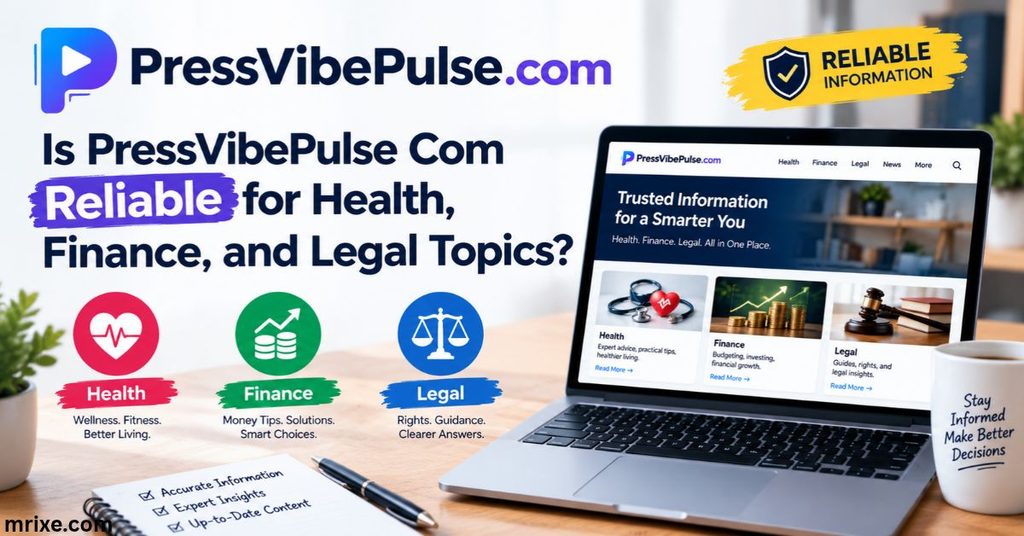
Short answer: use it as a starting point and never as the final word. The same advice applies to nearly every general-interest site on the web.
“Trust, but verify.” This Russian proverb became famous when U.S. President Ronald Reagan used it in the 1980s. It’s the perfect rule for reading any single website on a high-stakes subject.
Here’s where to confirm important claims:
| Topic | Better primary source | Link |
|---|---|---|
| Health and medicine | CDC, NIH, your doctor | cdc.gov / nih.gov |
| Taxes | IRS | irs.gov |
| Investing and securities | SEC | sec.gov |
| Consumer protection and ads | FTC | ftc.gov |
| Legal matters | Government statutes, licensed attorney | Your state or federal court site |
The reason is simple. A wrong travel tip costs you an annoying afternoon. A wrong dosage, tax deadline, or contract term can cost you health or money. Review sites that cover pressvibepulse com make the same recommendation. One advises readers to treat it as a starting point only and confirm any financial or health claim with a licensed professional or an authoritative publication.
Who Should Use PressVibePulse Com (and Who Should Look Elsewhere)
Different readers have different needs. Here’s how to decide if the site fits yours.
Good Fit
The site works well for:
- Casual readers who want quick explanations of trends
- Beginners looking to learn basic terms before deeper study
- Travel and lifestyle browsers hunting for ideas
- Writers and marketers scanning topics to spot themes
As one review explains, the platform may help people identify themes and terminology before moving into deeper research. That’s a smart use. Treat it as a map and not a destination.
Poor Fit
You should not rely on the site alone if you:
- Make medical, legal, or investment decisions
- Write school papers, news stories, or research that need citable sources
- Need breaking news with verified reporting
- Want expert-level analysis in a technical field
If you fall into one of these groups, open the primary sources instead. Then use the magazine for context only.
How to Use PressVibePulse Com More Safely
A few habits protect you every time you visit. They take almost no effort.
- Check the byline first. A real name beats an empty one.
- Verify the date. Skip outdated material on fast-moving topics.
- Follow the links. Click at least one source and confirm it says what the article claims.
- Cross-check one fact. Find the same claim on a government or established news site.
- Skip downloads and logins. A magazine shouldn’t need your password or a file download to read.
- Guard your data. Don’t enter personal or payment details on any site you haven’t verified.
- Use browser protections. Keep your browser updated and use Safe Browsing features.
- Watch for sponsored signals. Gushing product praise with affiliate links deserves extra skepticism.
Follow these steps and you’ll cut most of the risk on pressvibepulse com or any similar site.
PressVibePulse Com vs. Established Information Sources
How does a general magazine compare with trusted outlets? This table lays it out by category. The ratings reflect what a reader can typically expect from each source type.
| Factor | General web magazine like pressvibepulse com | Major news outlet | Government or medical agency |
|---|---|---|---|
| Named experts | Varies by article | Usually yes | Yes |
| Editorial standards | Check on site | Published and enforced | Formal review process |
| Corrections policy | Check on site | Typically public | Updates posted openly |
| Source depth | Mixed | Strong on reported news | Primary data |
| Speed | Fast | Fast | Slower |
| Ease of reading | High | Medium | Sometimes technical |
| Best use | Quick overviews | Verified news | Final answers |
The takeaway? Each source type plays a role. A magazine gives you quick orientation. A newsroom gives you verified reporting. An agency gives you the authoritative answer. Smart readers use all three in order.
Final Verdict on PressVibePulse Com in 2026
So where does that leave you? Here’s the bottom line.
pressvibepulse com is a real, HTTPS-enabled, multi-topic web magazine with about three years of history. Its range is wide and its writing style is simple. Those are real positives for casual readers. It also shows common traits of broad publishers: mixed article quality, guest-post exposure, and limited visible expert credentials.
The scorecard below reflects publicly reported signals. Update the numbers after your own visit.
| Area | Provisional score | Reason |
|---|---|---|
| Technical security | 4 out of 5 | HTTPS and mature infrastructure |
| Content breadth | 4 out of 5 | Seven categories |
| Reading ease | 4 out of 5 | Plain-English style |
| Author transparency | 2 out of 5 | Must be verified article by article |
| Source depth | 2 out of 5 | Varies by post |
| High-stakes reliability | 2 out of 5 | Needs outside confirmation |
Best advice: Use it for orientation, ideas, and everyday topics. Confirm anything that touches your health, money, or legal rights with an expert or an official source.
Frequently Asked Questions About PressVibePulse Com
What is pressvibepulse com?
It’s a multi-category web magazine. Its menu lists Health, Business, Travel, Technology, Finance, Fashion, and Lifestyle. It publishes plain-English guides and trending posts for general readers.
Is PressVibePulse com legit?
Reports indicate it’s a live site with HTTPS, a 2023 registration date, and Cloudflare infrastructure. That points to a real operation. Legitimacy doesn’t guarantee each article is accurate, so judge articles one at a time.
Is pressvibepulse com safe to visit?
HTTPS means your connection is encrypted. You can add a check with Google Safe Browsing. As always, avoid downloads and never enter passwords or payment details on a news-style site.
Is PressVibePulse com free to use?
Several reviews describe reading as free with no login. Confirm this by opening the site in a private browser window. Features and policies can change.
What topics does PressVibePulse com cover?
Technology, business, finance, health, travel, fashion, and lifestyle. Some reviews also mention trending topics and general headlines.
Is PressVibePulse com reliable for health and finance information?
Use it as a starting point only. Confirm health claims with the CDC, the NIH, or your doctor. Confirm money claims with the IRS, the SEC, or a licensed professional.
Does PressVibePulse com accept guest posts?
The domain has appeared in a third-party guest-post marketplace. That suggests outside contributions may exist. Check the site’s contact page for current submission rules.
Is pressvibepulse com the same as PressPulse AI?
No. PressPulse AI is a separate PR tool that matches experts with journalist requests. The two names look similar but the products are unrelated.
Who is pressvibepulse com best suited for?
Casual readers, beginners, and anyone gathering quick context on everyday topics. It’s less suited to researchers, students needing citable work, and people making big decisions.

Nathan Cooper is a humor writer who enjoys creating clever puns, witty jokes, and lighthearted content that brings smiles to readers. He loves sharing fresh, family friendly humor that’s fun, engaging, and easy to enjoy.