


Growth Navigate funding sounds like a place where you apply for cash. It’s not a lender or a fund. The company is an advisory service that helps business owners sharpen their pitch and meet investors. That difference changes how you should judge it.
This Growth Navigate funding review covers what the company offers in 2026 and what its website leaves out. You’ll also get a ten-minute checklist for vetting any funding advisor before you pay a cent.
Quick Verdict on Growth Navigate Funding
Growth Navigate is not a bank, a venture fund, or a lender. It’s an advisory and introduction service for business owners who want help raising money. That one fact should shape every decision you make about it.
Here’s the short version before the deep dive.
| Question | Answer |
|---|---|
| What is it? | An advisory platform focused on funding, coaching, and financial planning |
| Does it lend money directly? | No. It describes itself as a connector to investors and loan sources |
| Who is it for? | Founders and small business owners who want pitch and process support |
| What does the site publish? | Services, a four-step process, and unattributed testimonials |
| What’s missing from the site? | Fees, deal sizes, named clients, and regulatory registrations |
| Smart next step | Verify first and pay later |
Bottom line: Growth Navigate funding help may suit you if you want a coach who will tighten your pitch. It’s a poor fit if you expect cash from the company itself. Either way, run the vetting steps below before you sign or pay anything.
What Growth Navigate Actually Is
Plenty of articles use the phrase “growth navigate funding” as if it were a method. Some treat it as a staged approach that bridges validation capital at Seed and Series A with execution capital at Series B and beyond. That framing is fine as a concept. It just isn’t what a reader searching for a review wants to know.
The Company and Its Stated Mission
The site calls itself a platform that helps startups feature their products and expertise. It runs on Wix. The footer lists an address on Market Street in San Francisco and a copyright range of 2008 to 2025. As of this writing, that footer hasn’t been updated for 2026.
The site has two layers:
- A services layer. Five paid service lines cover funding, coaching, planning, investing, and fintech.
- A content layer. Pages cover startup tools, business models, failures, unicorns, interviews, and Fortune 500 lists.
Its tagline is blunt. The brand promises “No fluff. No wasted time. Just results.” That’s a bold promise. The rest of this review checks how much of it the page backs up.
Growth Navigate Funding Is Not a Lender
The funding page says the company connects you with investors and helps you navigate venture capital, angel investors, and business loans. Read that carefully. It describes introductions and preparation. It doesn’t describe the company writing checks.
This matters because the word “funding” in a company name makes many readers assume direct capital. It’s closer to hiring a guide than applying for a loan.
Names That Get Confused With Growth Navigate
Several programs share similar names. Mixing them up wastes your time.
| Name | Who runs it | What it does | Funds you directly? |
|---|---|---|---|
| Growth Navigate | Private company (growthnavigate.com) | Advisory, coaching, investor introductions | No |
| Growth Navigator (Vienna) | Vienna Business Agency | Growth program with workshops and coaching for startups already on the market | No, it’s a support program |
| Navigators Growth Track | Mina Foundation community | Grants for zkApps, infrastructure, and tooling projects | Yes, as grants |
| Navigate Accelerator | Miami-based startup advisory | Helps early companies launch and prepare for funding | No |
If you landed here looking for the Vienna program, note that one of its sprints has a deadline coming up. The Operational Excellence and Organization sprint was open for applications until October 19, 2026. Spots are tight. The agency’s announcement says it offers ten places per quarter.
Growth Navigate Services Breakdown
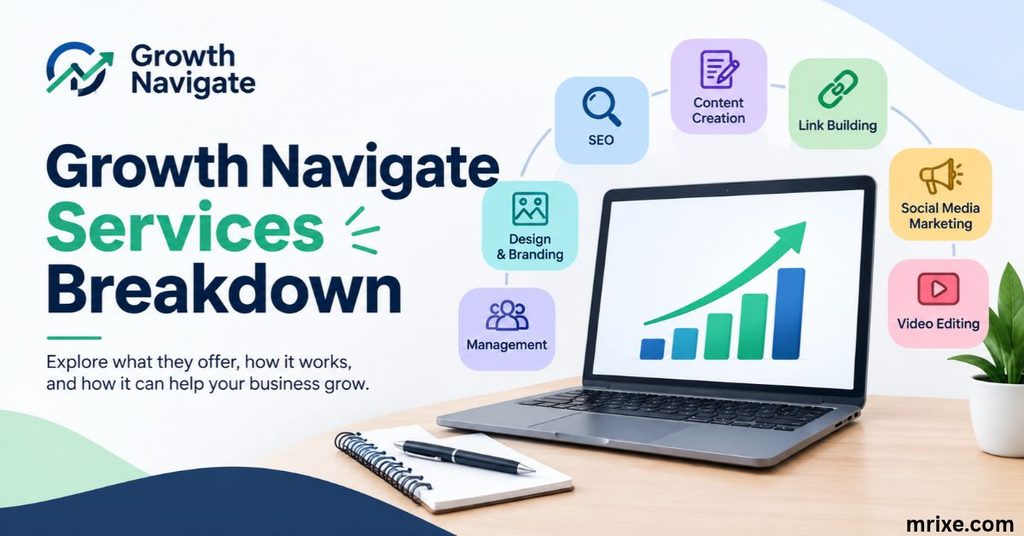
The site lists five service lines. Each one gets a short, plain description below.
Business Funding and Capital Acquisition
This is the core of Growth Navigate funding. The page promises three things:
- Introductions to investors
- Help building pitch decks
- Support structuring deals
It also lists a four-step process:
- Analysis and customization of your financial picture
- Strategic advisory to set goals
- Execution and optimization of the plan
- Continuous support after the work begins
That’s a standard consulting arc. Nothing on the page ties it to a timeline, a price, or a deliverable you can hold the company to.
Coaching, Financial Planning, and Fintech Services
The other four lines are broader:
- Business coaching and financial advisory covers general guidance for owners.
- Financial planning and risk management focuses on cash flow and systems.
- Investment strategy and wealth building reaches into personal finance.
- Digital transformation and fintech solutions covers software and process upgrades.
Notice the spread. A single small team covering startup fundraising, wealth building, and fintech is unusual. Deep expertise usually narrows. Ask which services have actual staff behind them.
Startup Tools and Resources
The “Startup Tools” section and blog work as a content hub. Third-party articles also reference the phrase “growth navigate startup tools” as a guide to scaling with business software. These pages can help with research. They don’t prove the advisory side delivers results.
Claims on the Page vs. Proof on the Page
The funding page lists several numbers. Here’s what each one actually shows.
| Claim on the page | What the page shows | What’s still unverified |
|---|---|---|
| “100+ successful partnerships” | A number in a stats block | Who the partners are and what “successful” means |
| “15+ years of financial expertise” | A number in a stats block | Whose experience and at which firms |
| Three testimonials | First and last names with quotes | Companies, titles, and results |
| Six client and partner logos | Unlabeled images | Which companies they represent |
None of this means the claims are false. It means you can’t confirm them from the page alone. That gap is the whole reason vetting matters.
Growth Navigate Funding Review: What Checks Out and What Doesn’t
A fair review lists both sides. Start with what holds up.
What Looks Solid
- The scope is clear. You know the categories of help on offer.
- The problem statement is accurate. The page says most businesses fail because they run out of money, scale too fast without a plan, or chase the wrong funding. Cash runway and poor planning are real causes of small business trouble.
- The contact details exist. There’s an email, an address, and links to social profiles.
What Raises Questions
Now the other side. These are observations from the pages themselves.
- No fees are published. You can’t compare cost against value.
- No deal sizes or funded amounts appear. The word “funded” shows up repeatedly. No dollar figure follows it.
- The testimonials lack companies. A quote from “Michael” with no business name proves little.
- The listed phone number sits in the 555 exchange. Those numbers are rarely assigned to real lines. Call it and see what happens.
- No registration details appear. A firm that arranges investor introductions should say what licenses it holds.
- The copyright range is stale. It still ends in 2025.
Any one item could have an innocent explanation. Together they mean you should do your own homework.
Why Fee Structure Matters Most
Fees decide whether an advisor works for you or off you. Here are the common structures.
| Fee type | How it works | Main risk for you |
|---|---|---|
| Upfront fee | You pay before any work | You carry all the risk if nothing closes |
| Monthly retainer | A fixed fee each month | Costs pile up while results lag |
| Success fee | A percentage of money raised | Regulatory questions (see below) |
| Hybrid | Small retainer plus success fee | Needs clear terms on what triggers each part |
The Federal Trade Commission warns consumers and small businesses about advance-fee schemes. In those, a company collects money to “arrange” funding that never arrives. Browse the agency’s guidance at ftc.gov.
Success fees raise a different issue. In the US, regulators treat pay tied to a securities deal as a hallmark of broker activity. A person who earns a percentage for raising investor money from an equity round may need broker-dealer registration. Ask any advisor to explain exactly how their pay works and what licenses cover it. Confirm current rules with a securities attorney before you rely on any arrangement.
How to Vet Growth Navigate Funding in 10 Minutes
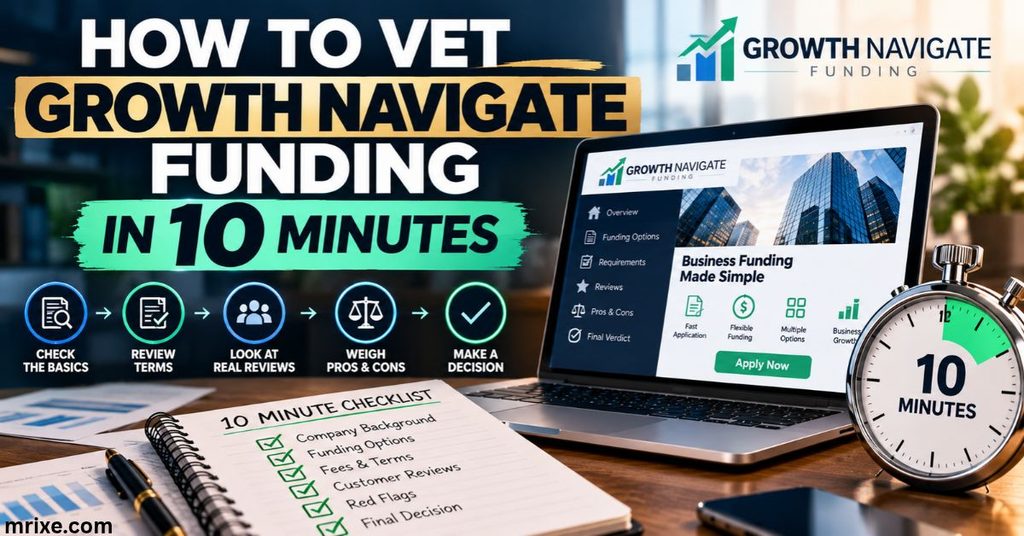
This checklist works on any funding advisor. Use it on Growth Navigate funding services or anyone else.
Check Registrations
Start with public databases. They’re free.
- FINRA BrokerCheck lists registered brokers and firms plus disciplinary history.
- SEC Investment Adviser Public Disclosure covers registered investment advisers.
- Your state’s business registry shows whether the listed company legally exists and who filed for it.
No listing doesn’t automatically mean wrongdoing. Some advisory work needs no license. It does mean you should ask why.
Check the Footprint
Look at how long and how visibly the company has operated.
- Search the domain on a WHOIS lookup to see its registration date.
- Open the company’s LinkedIn page. Look at employee counts and named leaders.
- Search each leader’s name. Check their work history for the claimed experience.
- Confirm the street address on a map.
A claim of 15+ years should match a trail of old press, filings, or client mentions.
Check the Clients
Ask for proof. A legitimate firm will provide it.
- Request three reference contacts with names and company names.
- Ask for two closed deals. Get the funder’s name and the amount.
- Call the references. Ask what they paid and what they got.
Rule of thumb: If an advisor won’t name a single funded client, treat every success claim as unproven.
Check the Contract
Read the agreement before you sign. Watch for these items:
- Fee triggers. When exactly do you owe money?
- Exclusivity. Are you locked out of other advisors?
- Tail clauses. Do they get paid for deals closed after you leave?
- Termination terms. How do you exit?
- Data and deck ownership. Who owns the materials they create?
Red flags to walk away from:
- Guaranteed funding
- Pressure to pay today
- Refusal to put promises in writing
- Requests for payment by gift card or wire to a personal account
Case Study: Two Ways a Funding Advisor Engagement Can Go
The two scenarios below are illustrative composites. They aren’t reports about Growth Navigate or its clients. They show how the fee structure shapes outcomes.
Scenario A: A Success-Fee Advisor With Named References
Maya runs a small software company with $1.2 million in annual revenue. She wants a $400,000 loan to hire two engineers. She hires an advisor who charges 5% of funds closed and nothing upfront. The advisor provides three client references. Maya calls two of them.
The advisor cleans up her financial statements and packages a loan application. A lender approves $400,000 in 11 weeks. Maya pays $20,000.
Scenario B: An Upfront-Fee Advisor With No Verifiable Track Record
Daniel runs a restaurant group. He wants $500,000 for a second location. He hires an advisor who charges a $6,000 setup fee plus $2,500 a month. The advisor promises “investor introductions” but names no investors.
Five months pass. Daniel gets two generic pitch-deck drafts and one call with an unnamed contact. No term sheet arrives. He has paid $18,500 and has no capital.
Side-by-Side Comparison
| Scenario A | Scenario B | |
|---|---|---|
| Fee model | Success fee only | Upfront plus retainer |
| Cost paid | $20,000 | $18,500 |
| Capital raised | $400,000 | $0 |
| References offered | Three, named | None |
| Lesson | Pay when results arrive | Pay-first models shift risk to you |
The takeaway is simple. The advisor with skin in the game had a reason to close the deal. The other had a reason to keep the retainer running.
Funding Paths Worth Comparing in 2026
Before you pay any advisor, know what capital sources exist. Many are free to apply to directly.
SBA-Backed Loans
The US Small Business Administration doesn’t lend directly. It guarantees part of loans made by banks and other lenders. That reduces lender risk. Review current programs at.
| Program | Typical use | Maximum amount |
|---|---|---|
| 7(a) loans | Working capital, equipment, expansion | Up to $5 million |
| 504 loans | Real estate and large equipment | Up to $5 million from the CDC portion for most projects |
| Microloans | Small startup needs | Up to $50,000 |
For 7(a) loans, the SBA guarantees 85% on loans up to $150,000 and 75% above that. Terms and fees change. Confirm current figures on the SBA site before you apply.
Venture Capital and Angel Investors
Equity investors take ownership in return for cash. They suit companies that can grow very fast. They rarely suit a stable local business. A bank loan costs less in ownership.
Revenue-Based Financing and Grants
Revenue-based financing repays a percentage of monthly sales until a cap is reached. It works for businesses with steady recurring revenue.
Grants and public programs give non-dilutive support. Examples include the Vienna program above and the Mina Foundation track. The Mina track requires proposals to include deliverables and a mid-point milestone for evaluation. Expect that kind of structure from most grant funders.
Matching Capital to Stage
Match your funding source to your stage. Here’s a simple guide.
| Stage | Typical source | Metric funders check |
|---|---|---|
| Validation | Founder savings, friends and family, small grants | Customer interviews and early paying users |
| Early traction | Angels, microloans, revenue-based financing | Monthly recurring revenue and retention |
| Scaling | Venture capital, SBA 7(a), bank credit | Unit economics and burn efficiency |
Three common benchmarks come up in scaling conversations:
- LTV to CAC ratio. Many investors look for about 3 to 1.
- CAC payback. Under 12 months is a widely used target for small business sales.
- Burn multiple. Divide net cash burned by net new annual recurring revenue. Under 1.5 is generally viewed as healthy. Above 3 draws concern.
Treat these as rules of thumb. They vary by industry and by investor.
Who Should Consider Growth Navigate Funding Services, and Who Should Skip Them
Reasonable Fit
Growth Navigate funding services could make sense if you:
- Want help with a pitch deck and financial story
- Prefer a coach to walk you through the process
- Will verify every claim and negotiate fees before signing
- Understand that introductions are not guarantees
Poor Fit
Skip it if you:
- Expect the company to supply capital directly
- Are asked for large upfront payments with no references
- Need a licensed broker for a securities offering and can’t confirm registration
- Want a fixed price and a written timeline you can’t get
Pros and Cons of Growth Navigate Funding
| Pros | Cons |
|---|---|
| Clear list of five service areas | No published pricing |
| Plain four-step process | No named clients or funded amounts |
| Free content on startup topics | Testimonials lack company names |
| Direct contact through email and social channels | No registration details on the pages reviewed |
| Covers funding, planning, and coaching in one place | Wide service range with no staff bios |
Final Verdict: Is Growth Navigate Legit?
The honest answer depends on what you can confirm. The company exists as a website with a defined service menu. It doesn’t prove its track record on the pages reviewed. It publishes no pricing. It isn’t a lender.
That makes the decision yours to test. Ask for references. Ask for fees in writing. Check registrations. If the answers come back clear and checkable, Growth Navigate funding support may save you time on your pitch. If they come back vague, move on. Plenty of free routes exist, from SBA lenders to public grant programs.
Your next step: Run the ten-minute checklist above. Then decide.
Frequently Asked Questions About Growth Navigate Funding
Is Growth Navigate a lender?
No. The company describes itself as a connector. It says it links you with investors and supports your pursuit of venture capital, angel funding, and business loans. It doesn’t present itself as the source of the capital.
Does Growth Navigate charge fees?
The pages reviewed don’t list any pricing. Ask for a written fee schedule before any call turns into a contract. Confirm whether fees are upfront, monthly, or tied to results.
Is Growth Navigate the same as Growth Navigator in Vienna?
No. The Vienna program is run by the city’s business agency. It offers four thematic blocks, including Product–Market Alignment and Sales and Go-to-Market, with expert input and coaching. It’s unrelated to growthnavigate.com.
How do I verify a funding advisor?
Check FINRA BrokerCheck and the SEC adviser database. Look up the company in your state registry. Call named references. Read the contract for fee triggers and exit terms.
What should I never pay upfront?
Be wary of any large fee collected before work starts, especially when the advisor promises funding. Never pay by gift card or to a personal account. Ask for a written scope of work first.
What are Growth Navigate startup tools?
The phrase points to the site’s startup tools section and to third-party articles about software for scaling a startup. These are informational resources. They’re separate from the advisory services.

Nathan Cooper is a humor writer who enjoys creating clever puns, witty jokes, and lighthearted content that brings smiles to readers. He loves sharing fresh, family friendly humor that’s fun, engaging, and easy to enjoy.