

You tap a button on the screen. The steering feels heavier. The pedal gets sharper. Then a thought hits you: did I just burn through my battery?
That’s a fair worry. The LYRIQ carries a big 102 kWh pack, and you paid good money for those miles. So do the driving modes in cadillac lyriq offer different ranges or battery usages? Yes, in practice they can. But the reason matters more than the answer.
Here’s the catch. The modes don’t change the battery. They change how the car responds to your foot, your hands, and the road. Those changes shape how you drive, and your driving shapes your range. This guide breaks down every mode, shows what the EPA numbers really mean, and gives you simple math so you can judge the trade-offs yourself.
The Short Answer
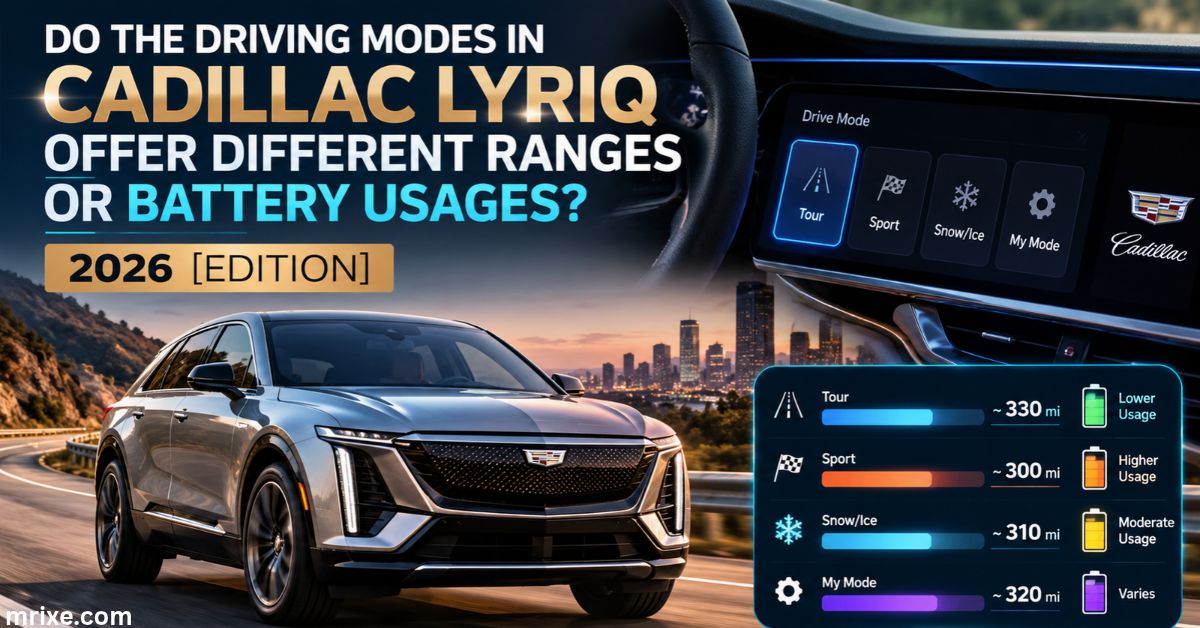
Yes, but indirectly. Each LYRIQ drive mode changes pedal response, steering feel, and brake feel. Those settings influence how much energy you use per mile. Cadillac doesn’t publish a separate range rating for each mode, so no official “Tour gets X miles, Sport gets Y miles” chart exists.
Here’s the quick version:
- Tour: The default. Smooth and calm. Best match for efficient daily driving.
- Sport: Sharper torque response. Easy to overuse, so range usually drops if you drive harder.
- Snow/Ice: Built to limit wheel spin. It’s about grip, not about saving energy.
- My Mode: You build it. Set it gentle, and it can match Tour. Set it aggressive, and it acts like Sport.
- V Mode (LYRIQ-V only): A deeper performance setup with suspension and competitive presets.
Rule of thumb: The mode sets the mood of the car. Your right foot, your speed, and the weather set the bill.
What a Driving Mode Actually Changes in the Cadillac Lyriq
A drive mode is a software preset. Think of it like a playlist. The songs (your hardware) stay the same, but the order and volume change.
According to Cadillac’s own feature descriptions, the mode selector can adjust:
- Accelerator responsiveness: How quickly the car delivers torque when you press the pedal.
- Steering feel: How heavy or light the wheel feels, especially at higher speeds.
- Brake responsiveness: How the brake pedal and regen behave.
- Electric Vehicle Sound Enhancement: The synthetic sounds the car plays for you and for pedestrians.
What modes don’t change
Some things stay fixed no matter which mode you pick:
- Battery size: The pack stays at 102 kWh across the 2026 lineup.
- Motor hardware: The motors don’t swap or resize.
- The EPA rating: The official range figure doesn’t shift with your mode choice.
- Charging speed: Your DC fast-charging curve belongs to the battery, not the mode.
How a mode can still change your range
Here’s the logic. A sharper pedal makes it easier to launch hard from stoplights. Harder launches pull more power. More power per mile means fewer miles per charge. A mode doesn’t force you to waste energy. It just makes wasting energy easier.
That’s why this topic confuses people. The mode isn’t the villain. Your habits inside the mode are.
The Cadillac Lyriq Drive Modes Lineup
You pick modes from the Drive Mode app on the center screen. Cadillac gives you four standard choices. The performance LYRIQ-V adds one more.
Tour Mode
Tour is the default. Cadillac describes it as the main everyday mode, tuned for a smooth ride. The pedal feels progressive. The steering feels relaxed. Nothing grabs you.
Why it helps range:
- The pedal ramps up power gradually, so you accelerate more evenly.
- Smoother inputs reduce the sharp power spikes that eat miles.
- It pairs naturally with gentle regen use in town.
Best for: Commutes, errands, highway cruising, and long road trips.
Tour also stays on after you power down and restart the car. You won’t have to reselect it each morning.
Sport Mode
Sport sharpens everything. Cadillac says it’s calibrated for a stronger feeling of road connection. You get more immediate torque response and improved steering at higher speeds.
What you’ll notice:
- The car jumps forward faster when you press the pedal.
- The steering feels tighter and more direct.
- The whole car feels more alert.
What it does to range: Sport doesn’t secretly drain the battery while you’re parked or coasting. But the quicker pedal invites faster acceleration. If you drive Sport like Tour (gentle and steady), you’ll lose little. If you use that punchy response every time, you’ll lose more.
Sport also stays active after a restart, just like Tour.
Snow/Ice Mode
Snow/Ice exists for slick roads. Cadillac says it helps prevent wheel spin in snow or other slippery conditions. It adjusts how torque reaches the wheels.
Key facts:
- It’s built for traction, not efficiency.
- It’s meant for slippery pavement, not for digging out of deep snow or mud (GM Authority makes this point in its drive modes explainer).
- It resets to Tour when you shut the car off. You’ll need to turn it back on after each restart.
That reset catches many owners off guard. You start your morning drive on an icy street, forget to select Snow/Ice, and wonder why the car feels livelier than expected.
My Mode
My Mode is your custom recipe. Cadillac says it lets you change accelerator responsiveness, steering feel, braking responsiveness, and sound enhancement.
Two smart ways to use it:
- The efficiency build: Soft accelerator, strong regen braking, light steering. This setup can feel a lot like Tour.
- The fun build: Quick accelerator, firm steering, strong brake feel. This acts much like Sport.
My Mode also stays selected after a restart. That makes it a handy “set it once” option.
V Mode (LYRIQ-V Only)
The LYRIQ-V, Cadillac’s 615-horsepower performance model, gets an extra layer. V Mode lets you tune the accelerator pedal, brake pedal, suspension, steering, and sound. It also includes a competitive mode preset.
If you own a standard LYRIQ, skip this one. If you own a V, remember that V Mode is a performance tool. Treat it like a track-day setting, not a daily-commute setting.
Drive Mode Comparison Table
| Mode | Main Purpose | Pedal Feel | Stays On After Restart? | Efficiency Intent |
|---|---|---|---|---|
| Tour | Everyday comfort | Smooth, progressive | Yes | Highest |
| Sport | Athletic driving | Quick, responsive | Yes | Lower |
| Snow/Ice | Slippery roads | Softer torque delivery | No (resets to Tour) | Not the goal |
| My Mode | Your custom setup | You decide | Yes | Depends on settings |
| V Mode (V only) | Performance tuning | You decide, plus presets | Check your owner’s manual | Low priority |
2026 Cadillac Lyriq Range by Trim: The Official EPA Numbers
Before you judge any mode, you need the baseline. EPA range numbers come from standardized lab testing. They don’t change when you swap from Tour to Sport on your screen.
The 2026 LYRIQ lineup uses a 102 kWh battery across the board. Range changes by drivetrain, charger, and trim.
| 2026 Configuration | EPA Range | Notes |
|---|---|---|
| Single-motor (rear-wheel drive) | 326 miles | Best range in the lineup |
| Dual-motor AWD (standard charger) | 303 miles | Extra motor adds weight and draw |
| Dual-motor AWD (19 kW charger) | 319 miles | Charger option changes the rating |
| LYRIQ-V | About 285 miles | 615 hp, stickier tires, more weight |
You can check ratings for any trim at fueleconomy.gov. Kelley Blue Book also lists the 303-to-326-mile spread for the 2026 model.
Efficiency ratings you can use
The EPA rates the single-motor LYRIQ at about 100 MPGe in the city and 83 MPGe on the highway. The AWD version lands at about 93 city and 77 highway. Notice how the highway number drops. That tells you something important: speed hurts more than almost anything else.
What the EPA number really tells you
EPA range is a standardized benchmark. It’s useful for comparing cars. It doesn’t promise you’ll hit that exact distance on your commute.
Your real range depends on:
- Your speed
- The temperature outside
- Your tires and wheels
- Your cargo and passengers
- Your driving style
The mode you pick sits inside that last bucket.
Do the Driving Modes in Cadillac Lyriq Offer Different Ranges or Battery Usages? What You Can Count On
Let’s separate what’s solid from what’s guesswork.
What Cadillac documents
Cadillac documents what each mode adjusts. It doesn’t document a mode-by-mode range chart. So you won’t find an official line saying “Sport reduces range by 12 percent.” Any website that states an exact percentage as fact is working from owner anecdotes or its own assumptions.
What basic EV physics tells you
Electric motors turn battery energy into motion. Harder acceleration pulls higher power for a short burst. After the burst, you carry more speed. If you brake later, that extra speed disappears as heat and partial regen recovery. You rarely get all the energy back.
Because of this, aggressive driving always costs range in any EV. The LYRIQ is no exception.
What this means for the LYRIQ
- Tour encourages smoother driving, so it tends to support better efficiency.
- Sport makes aggressive driving more tempting, so it tends to reduce efficiency if you use the extra response.
- My Mode can land anywhere between the two, depending on your settings.
- Snow/Ice matters most for safety and grip.
Plain truth: A gentle driver in Sport can beat an aggressive driver in Tour.
That sentence holds up better than any fixed percentage. Mode choice matters. Your foot matters more.
How Much Range Do You Lose in Sport Mode? Simple Math You Can Trust
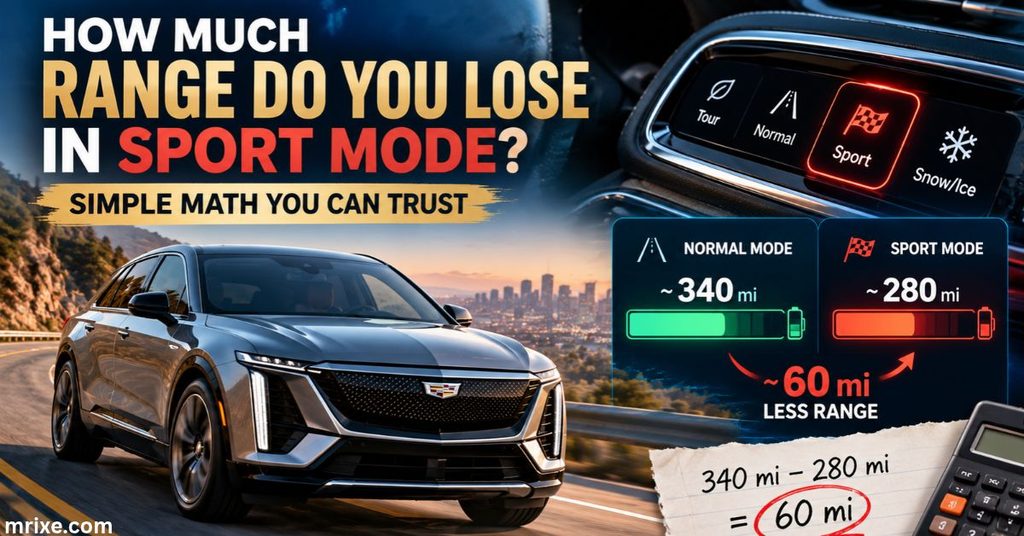
Since Cadillac publishes no per-mode figure, you can build a reasonable estimate yourself. This uses the 102 kWh pack figure as a round number and a typical efficiency range for large electric SUVs.
The efficiency math
Range equals efficiency times battery size. Efficiency here means miles per kWh.
| Driving Style (Illustrative) | Efficiency | Estimated Range on 102 kWh |
|---|---|---|
| Gentle, steady | 3.0 mi/kWh | About 306 miles |
| Moderate, mixed | 2.7 mi/kWh | About 275 miles |
| Spirited, frequent hard launches | 2.4 mi/kWh | About 245 miles |
Notice the spread. From gentle to spirited, you’d lose roughly 60 miles. That’s a drop of about 20 percent. The numbers above are illustrative math, not lab results. They show how quickly range shifts when efficiency moves by only a few tenths of a mile per kWh.
Why Sport can push you toward the lower rows
Sport makes the pedal more eager. You feel more power per inch of travel. Many drivers press harder without noticing. Over a month of commuting, small pedal habits add up.
Case Study: The Daily Commuter (Illustrative Scenario)
Meet a driver with a 40-mile round-trip commute. This scenario uses the math above and isn’t a real owner report.
- In Tour at 3.0 mi/kWh: The commute uses about 13.3 kWh.
- In Sport at 2.5 mi/kWh: The same commute uses about 16 kWh.
- Difference per day: About 2.7 kWh.
- Over 250 workdays: About 675 kWh.
At a home electricity rate of 15 cents per kWh, that’s roughly $100 a year. Not catastrophic. But for someone who hates wasted energy (or someone who relies on public fast charging at higher prices), it adds up.
The commute still works fine in either mode. The real cost shows up on longer trips when charging stops matter.
Case Study: The Road Tripper (Illustrative Scenario)
Imagine a 300-mile highway trip planned around a single charge in the single-motor LYRIQ.
- At 3.0 mi/kWh: You’d barely make it with a small buffer.
- At 2.5 mi/kWh: You’d need a charging stop around the 250-mile mark.
- At 2.2 mi/kWh: You’d stop earlier and more often.
In this case, mode choice isn’t the biggest factor. Highway speed is. Still, if Sport makes you accelerate harder after every slowdown, it can push you toward the lower rows. Tour keeps your pace steadier. Cruise control helps too.
Why Snow/Ice Mode Isn’t About Saving Range
Snow/Ice mode has one job. It helps you keep traction.
What it does
The mode manages how torque reaches the wheels. This helps reduce wheel spin on snow, slush, ice, and wet roads. You get calmer starts and less drama.
Does it save battery?
No. Don’t pick it expecting better mileage. It’s a safety tool.
Why winter range drops anyway
Cold weather hurts every EV. AAA’s 2019 testing of several EVs found average range fell about 41 percent at 20°F when cabin heat ran. The LYRIQ isn’t immune to winter physics. Reasons include:
- Cold battery chemistry: Cells deliver less usable energy when cold.
- Cabin heating: Warming the interior pulls real power from the pack.
- Denser air: Cold air creates slightly more aerodynamic drag.
- Winter tires: Softer rubber compounds create more rolling resistance.
- Wet or slushy roads: Wheels push through water and slush.
So if your range falls in January, don’t blame Snow/Ice. Blame cold air, heating, and road conditions. The mode contributes very little compared with those factors.
A smart winter routine
- Precondition while plugged in. Warm the cabin and battery using grid power, not battery power.
- Choose Snow/Ice only when roads are slick. Remember it resets after a restart.
- Use seat and steering wheel heat if available. Heating your body takes less energy than heating the whole cabin.
- Keep tires at the recommended pressure. Cold air lowers tire pressure.
Regenerative Braking: Where Drive Modes Meet Battery Efficiency
Regen braking turns your car’s motion back into electricity when you slow down. It’s a big part of EV efficiency, especially in city driving.
Regen on Demand
The LYRIQ offers Regen on Demand. Per Cadillac, it lets you “slow down and stop your LYRIQ using only the accelerator” in most conditions. Many people call this one-pedal driving. A pressure-sensitive paddle on the steering wheel also lets you add regen braking on command.
Why regen matters for range
- City driving: Lots of stops and slowdowns give regen many chances to recover energy.
- Highway driving: Few slowdowns mean regen helps less.
- Downhill stretches: Regen can recapture energy you’d otherwise lose to the friction brakes.
How regen connects to mode choice
My Mode lets you tune brake responsiveness. A stronger regen feel encourages you to lift off the pedal early. Early lift-off plus smooth regen is one of the best efficiency habits in any EV.
Regen doesn’t create energy. It returns part of what you already spent. You won’t recover everything. But steady use can add a meaningful number of miles over a week.
Regen quick tips
- Lift early when you see a red light ahead.
- Use the paddle for extra deceleration without touching the brake pedal.
- Avoid late, hard braking. That wastes more energy as heat.
- Expect weaker regen when the battery is full or very cold. The system limits how much energy it can push back into the pack.
How to Test Your Cadillac Lyriq Drive Modes Range Yourself
Forget internet percentages. Your car, your roads, and your habits matter most. A simple test gives you real data.
The test method
- Pick one route. Choose a loop of 20 to 40 miles that you drive often.
- Keep conditions consistent. Same time of day, similar temperature, same tire pressure.
- Keep climate settings the same. Use identical fan speed and temperature.
- Drive the route in Tour. Record your energy use or miles per kWh.
- Drive it again in Sport. Change nothing else.
- Repeat in My Mode if you’ve customized it.
- Compare results.
What to track
| Run | Mode | Distance | Energy Used | Miles per kWh | Notes |
|---|---|---|---|---|---|
| 1 | Tour | ||||
| 2 | Sport | ||||
| 3 | My Mode |
Tips for a fair test
- Run each mode at least twice. Traffic can swing a single result.
- Test on dry days. Rain adds drag.
- Skip hills if possible. Or run the loop both directions.
- Drive normally. Don’t change your habits just because a mode changed.
You’ll learn something no article can tell you. You’ll see how your driving style interacts with your mode settings.
What Moves Range More Than Mode Selection
If you want to stretch your LYRIQ, these factors usually outweigh your mode choice.
Highway speed
Air resistance grows quickly with speed. Going from 65 mph to 75 mph raises aerodynamic drag force by about 33 percent. The power needed to overcome it climbs even faster. That’s why the highway MPGe figure sits below the city figure.
A simple trade: Slowing from 75 mph to 65 mph on a long drive costs you a few minutes. It can save a charging stop.
Temperature
Extreme cold and extreme heat both reduce range. Cold hurts more because it affects battery performance and forces heavy cabin heating. Hot weather mainly raises air conditioning load.
Tires and wheels
The LYRIQ comes with different wheel and tire options. Larger wheels and wider, grippier tires can look great. They can also add rolling resistance. The LYRIQ-V’s 285-mile rating reflects its performance tires and extra weight.
Tire pressure
Underinflated tires create more rolling resistance. Check pressure monthly. Check it more often in winter.
Weight and cargo
Every pound takes energy to move. Roof racks add drag. Heavy cargo adds load. Remove what you don’t need.
Preconditioning
Warming or cooling the car while plugged in uses grid energy instead of battery energy. You leave with a comfortable cabin and a fuller pack.
Driving style
Smooth acceleration, early lift-off, and steady speeds beat any mode setting.
Range factor ranking
| Factor | Typical Impact on Range | How Much Control You Have |
|---|---|---|
| Highway speed | High | Full |
| Cold weather | High | Limited |
| Driving style | Medium to high | Full |
| Tires and wheels | Medium | At purchase |
| Tire pressure | Low to medium | Full |
| Cargo and racks | Low to medium | Full |
| Drive mode | Low to medium (through behavior) | Full |
| Preconditioning | Medium in extreme weather | Full |
Which Cadillac Lyriq Driving Mode Should You Use? Practical Takeaways by Use Case
Here’s a quick guide matched to real situations.
Daily commute
Use Tour. It’s the default for a reason. It’s smooth and efficient. You can tap into regen for city stops.
Long highway trips
Use Tour or an efficiency-tuned My Mode. Set a steady speed with cruise control. Plan stops using your trip data, not the EPA number alone.
Winter mornings with icy roads
Use Snow/Ice. Remember to reselect it after every restart. Precondition before you leave if you can.
Back roads and fun drives
Use Sport. You bought a Cadillac EV with real power. Enjoy it. Just plan your charging a bit more conservatively.
Mixed driving with a personal touch
Use My Mode. Build an efficiency setup for weekdays. Save the sporty pedal for weekends if you’d like a second profile feel.
LYRIQ-V owners
Use Tour for daily driving. Save V Mode for spirited drives or track days. The V is already the lowest-range LYRIQ, so efficient habits count even more.
Use case summary
| Situation | Best Mode | Why |
|---|---|---|
| Commuting | Tour | Smooth, efficient |
| Highway road trip | Tour or efficient My Mode | Steady energy use |
| Snow or ice | Snow/Ice | Helps limit wheel spin |
| Fun driving | Sport | Quick response |
| Custom comfort | My Mode | Fully adjustable |
| Track-style driving (V) | V Mode | Performance tuning |
Common Myths About Cadillac Lyriq Battery Usage and Drive Modes
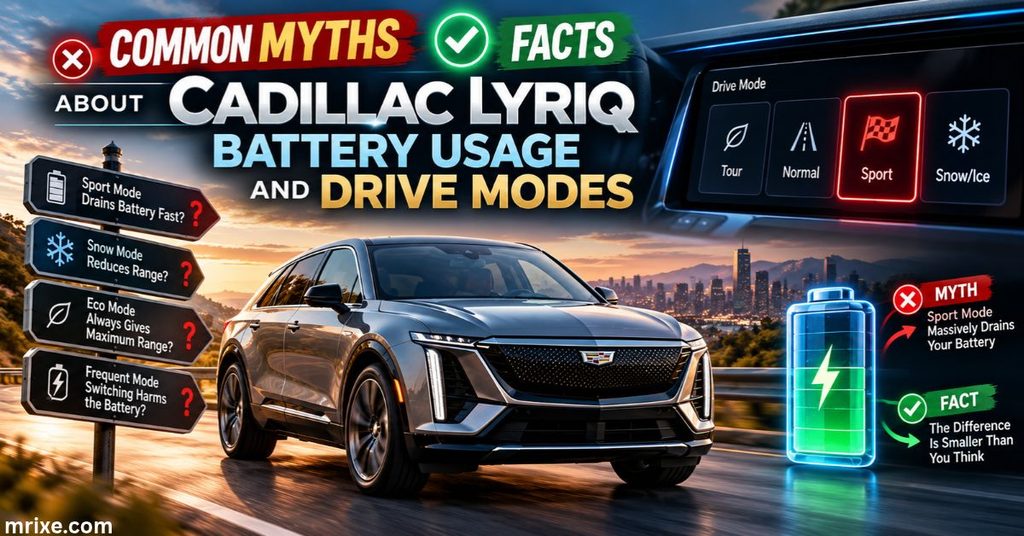
A few ideas float around owner forums. Some are half right. Some miss the point.
Myth: Sport mode drains the battery even when you’re not accelerating
Reality: Sport changes how the car responds. It doesn’t make the pack leak energy at a stoplight. The cost comes from how you drive in it.
Myth: Snow/Ice mode saves energy by limiting power
Reality: It limits wheel spin, which isn’t the same thing. Winter range still drops because of cold and heating loads.
Myth: Tour mode always gets the longest range
Reality: Tour usually helps. But a carefully tuned My Mode can match it. A heavy-footed driver in Tour can still lose range.
Myth: The EPA number changes with your mode
Reality: EPA testing is a standardized process. Your driving mode doesn’t alter the rating.
Myth: One setting works best for everyone
Reality: Roads, climate, and habits differ. A hilly commute with lots of stops behaves differently than a flat highway run.
Frequently Asked Questions About Cadillac Lyriq Drive Modes and Range
Do driving modes really change the Cadillac Lyriq’s range?
They can, but indirectly. Modes change pedal, steering, and brake feel. Those changes influence how you drive. Your driving style changes your energy use. Cadillac doesn’t publish a per-mode range figure.
Which mode should I use for daily driving?
Tour. Cadillac designed it for everyday use. It supports smooth driving and works well with regen braking.
Does Sport mode always cut range by the same amount?
No. The loss depends on how hard you drive. A calm drive in Sport costs little. Frequent hard launches cost more. No fixed percentage applies to every driver.
Does Snow/Ice mode help or hurt efficiency?
It isn’t designed for efficiency. It helps traction on slick roads. Winter range loss comes mainly from cold weather and cabin heating.
Can My Mode match Tour’s efficiency?
Yes, it can come close. Set a gentler accelerator response and a stronger regen feel. Then drive smoothly.
Does the mode I pick change the EPA rating?
No. The EPA rating comes from standardized testing. It stays the same no matter which mode you choose.
Which modes stay on after I turn the car off?
Tour, Sport, and My Mode stay selected after a restart. Snow/Ice resets to Tour.
Does the LYRIQ-V behave differently from the standard LYRIQ?
Yes. The V adds V Mode with extra tuning for suspension, pedals, steering, sound, and a competitive preset. It also carries a lower EPA rating of about 285 miles.
Is there a way to improve range without changing modes?
Absolutely. Slow down on the highway, keep tires inflated, precondition while plugged in, and lift off the pedal early.
How can I check my actual battery usage?
Run the simple test described above. Drive one route in each mode and log your miles per kWh. Real numbers beat guesses.
Final Word: Do the Driving Modes in Cadillac Lyriq Offer Different Ranges or Battery Usages?
Let’s wrap it up with a straight answer. Do the driving modes in cadillac lyriq offer different ranges or battery usages? Yes, they can. But they work through your habits, not through hidden battery controls.
Here’s what to remember:
- Tour gives you the smoothest path to efficient driving.
- Sport trades some range for quicker response. The bigger your hard-launch habit, the bigger the trade.
- Snow/Ice protects your grip. It won’t save you miles.
- My Mode gives you control. Tune it gently, and it can match Tour.
- V Mode belongs to the LYRIQ-V and leans toward performance.
- The EPA rating stays the same. It’s 326 miles for the single-motor, 303 or 319 miles for dual-motor AWD, and about 285 miles for the V.
The best range boost isn’t a button on the screen. It’s a steady speed, early lift-off, good tire pressure, and a preconditioned cabin. Use Tour for most days. Pick Sport when you want to smile. Use Snow/Ice when the road turns slick. Then run your own test and let your numbers decide.

Nathan Cooper is a humor writer who enjoys creating clever puns, witty jokes, and lighthearted content that brings smiles to readers. He loves sharing fresh, family friendly humor that’s fun, engaging, and easy to enjoy.