
You type a name into Google and expect an app. Maybe a mood tracker, a team dashboard, or a clever wellness tool. Then the page loads and you see something different.
That’s the experience many people describe with onlyworkmoods com. The name sounds like software. The site reads like a blog.
This guide clears up the confusion. You’ll learn what the site is, what it publishes, and how to judge it for yourself. You’ll also get the research behind the idea of workplace mood, a safety checklist, and real alternatives if you wanted a tracker. Let’s dig in.
What Is OnlyWorkMoods com? The Short Answer
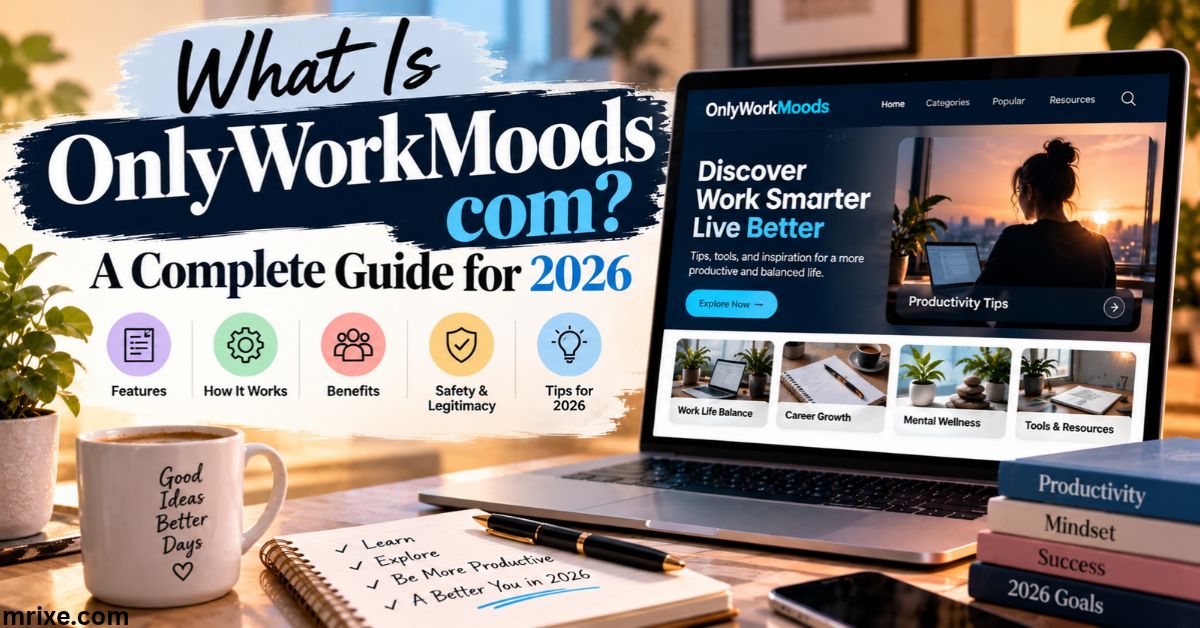
OnlyWorkMoods.com is a content website about work life. It publishes short, article-style pages on subjects like productivity, motivation, careers, and workplace wellbeing. You read it. You don’t log into it.
That’s the simplest way to put it. The name hints at a product, but the site works more like a small online magazine. There’s no mood chart to fill in and no team dashboard to manage.
Here’s a quick-facts snapshot:
| Detail | What to expect |
|---|---|
| Site type | Blog-style content site |
| Main purpose | Articles about work habits, focus, careers, and workplace wellbeing |
| Software or app | No downloadable app or tracking tool described by most reviewers |
| Account required | Not for reading |
| Cost to read | Free to browse |
| Best for | Quick ideas and light inspiration |
| Not suited for | Medical, legal, or HR decisions |
Think of it as a coffee-break read. It can spark an idea. It can’t replace a counselor, a lawyer, or a manager’s honest feedback.
What the Site Is Not
Let’s clear away the common myths. A lot of searchers arrive with the wrong picture in their heads.
OnlyWorkMoods.com is not:
- A mood-tracking app where you log how you feel each day
- A workplace analytics platform for HR teams
- A therapy or counseling service
- A job board or recruiting site
- A paid membership community
Why does this matter? Because the wrong expectation wastes your time. If you want to track your emotions, you’ll bounce within seconds. If you want a few practical reading ideas, you might stay.
The distinction also protects you. Never enter sensitive personal details into any site unless you understand how it handles data. A reading site shouldn’t ask for them anyway.
Why Descriptions of onlyworkmoods com Contradict Each Other
Search for the site and you’ll find a messy mix of opinions. Some pages call it a “productivity platform.” Others call it a blog. A few describe features that sound like an app.
Why the mismatch? Three reasons stand out.
First, the name misleads. “Work” plus “moods” suggests a tool. Writers who never visit the site often assume it works like one.
Second, copycat content spreads fast. One writer publishes a guess. Others rephrase it. Within weeks, dozens of articles repeat the same shaky claims.
Third, small sites rarely get proper coverage. Major publications don’t review niche blogs. So aggregator sites fill the gap, often without checking anything.
Here’s how to tell reliable descriptions from unreliable ones:
| Claim you might read | How to test it |
|---|---|
| “It’s an app you can download” | Search the Apple App Store and Google Play for the name |
| “It tracks your mood” | Look for a login button, dashboard, or charts on the site |
| “It’s backed by experts” | Check for named authors and credentials on article pages |
| “It’s trusted by thousands” | Ask where the number comes from, because no source usually means no proof |
| “It’s brand new” | Look up the domain’s registration date |
Rule of thumb: If a review can’t tell you something you could verify in two minutes, treat it as opinion.
This habit helps far beyond one website. It works any time a search result sounds too confident.
What You’ll Find on OnlyWorkMoods.com
Now for the real question. What happens when you actually land on the site?
Content Format
Expect short, readable articles. The tone is casual. The pages are built for quick scanning rather than deep study.
That format suits a specific reader. Picture someone on a lunch break, scrolling for a tip to get through the afternoon. They don’t want a 40-page whitepaper. They want one idea they can use today.
Typical features of this format include:
- Plain language with little jargon
- Short paragraphs and clear subheadings
- Lists of tips or habits
- General advice rather than data-heavy analysis
- A beginner-friendly approach
The tradeoff? Short articles can’t cover nuance. A 600-word piece on burnout can’t replace a clinician’s assessment. Keep that limit in mind.
Topic Range
Coverage centers on work and professional life. Reviewers describe a handful of recurring themes. The exact mix may shift as the site publishes more, so browse the categories yourself.
| Topic area | What it usually covers |
|---|---|
| Motivation | Staying driven through slow weeks and tough shifts |
| Productivity | Time management, task planning, and focus habits |
| Career growth | Skill building, job changes, and asking for raises |
| Workplace wellbeing | Stress, burnout signs, and healthy boundaries |
| Work culture | Remote work, hybrid teams, and office dynamics |
| Adjacent topics | Light takes on money, technology, and lifestyle |
Notice something about that list. Every topic connects to one question: how do you feel while you work, and what can you do about it? That’s the thread tying the site together.
Some categories are broader than others. Personal finance and technology articles, for example, feel like side roads from the main highway. They fit the theme only loosely.
Who Runs It
Here’s a point where honesty beats guesswork. Small blogs often don’t publish detailed ownership information. Some list an editor. Others share only a contact page or a generic “team” label.
You shouldn’t take anyone’s word for it, including mine. Check it yourself in under five minutes:
- Open the About page and look for names, a mission statement, and a contact method.
- Search the domain at the ICANN Lookup tool to see the registrar and the registration date.
- Check the Wayback Machine at web.archive.org to see how the site looked in earlier years.
- Read the privacy policy. A real site explains what it collects.
- Look at article bylines. Named authors with credentials earn more trust than anonymous posts.
Many domain owners use privacy protection, so a hidden name isn’t automatically a red flag. However, a site that hides everything and also pushes aggressive ads deserves extra caution.
Why So Many People Search for onlyworkmoods com
Odd names create curiosity. And this one stands out.
People reach the site through several paths:
- Direct curiosity. They saw the name somewhere and want to know what it is.
- Mistaken expectations. They assumed it was a mood-tracking app.
- Random discovery. They clicked an article while searching for work tips.
- Review hunting. They want to confirm the site is safe before clicking.
That last group matters most. Searching for “is it legit?” before visiting a new site is smart behavior. Online scams cost people billions every year. A quick check costs you nothing.
There’s also a bigger trend at play. Work has changed. Remote and hybrid setups blurred the line between home and office. As a result, more people search for ways to manage their energy, not just their schedules. Words like “mood,” “burnout,” and “balance” now show up in everyday work conversations.
So a site pairing “work” with “moods” taps into a real interest, even if the product behind it is simple.
How the OnlyWorkMoods.com Site Is Structured
Most blog-style sites follow a familiar pattern. Understanding it helps you move around faster.
Typical structure:
- Homepage: Shows recent articles and featured posts
- Category pages: Group articles by topic
- Article pages: The main content, with headings and short sections
- About and contact pages: Basic information about the publisher
- Legal pages: Privacy policy and terms
Navigation should feel simple. You don’t need a tutorial. There’s no onboarding flow, no setup wizard, and no dashboard to learn.
Reading tips for faster results:
- Use the category menu to jump to the topic you need
- Check the publish date before trusting any advice
- Skim subheadings first, then read what matters
- Open two or three articles on one subject and compare them
Why dates matter: Work advice ages quickly. A remote-work tip from 2020 may ignore how offices operate today.
If you find undated articles, treat them with extra care. Undated content makes it hard to judge whether information is still current.
Is OnlyWorkMoods.com Safe to Visit? A Practical Checklist
This is the question many readers care about most. So let’s treat it seriously.
No outsider can promise any website is perfectly safe. Sites change owners. Ads change networks. What you can do is run a quick safety check every time you visit an unfamiliar domain.
Use this table as your guide:
| Check | What a safe site looks like | Warning signs |
|---|---|---|
| HTTPS | Padlock icon in the address bar | “Not secure” warning |
| Pop-ups | None, or very few | Constant pop-ups or forced redirects |
| Downloads | Never asks you to install anything | Prompts for software or browser extensions |
| Contact info | Working email or form | No contact method at all |
| Privacy policy | Clear, readable page | Missing or copied text |
| Content quality | Original writing with consistent style | Scraped, garbled, or contradictory text |
| Requests for data | None for simple reading | Asks for passwords, cards, or phone numbers |
Three golden rules for any site like this:
- Never download anything a reading site asks you to install.
- Never enter payment details unless you’ve verified the business.
- Close the tab if you see aggressive redirects or fake virus alerts.
For extra peace of mind, keep your browser updated and use a reputable security tool. Also consider reading the site in a private window the first time.
The bottom line? A simple blog that asks for nothing and shows no suspicious behavior carries low risk. Your own habits matter more than any single site’s reputation.
OnlyWorkMoods com Pros and Cons

No site is perfect. Here’s a fair look at both sides.
What It Does Reasonably Well
Simple, approachable writing. You don’t need an HR degree to follow the articles. The language stays plain and friendly.
Quick reads. Busy workers rarely have an hour to spare. Short pieces fit into coffee breaks.
Broad topic coverage. One site touches motivation, careers, and wellbeing. That variety helps if you’re not sure what you need.
No barrier to entry. You don’t register, pay, or download. You click and read.
A relevant theme. Linking mood and work performance is not a gimmick. The research supports the connection, as you’ll see below.
Where It Falls Short
Limited depth. General tips rarely solve specific problems. A person facing workplace harassment needs more than a listicle.
Unclear expertise. When authors lack visible credentials, you can’t judge the advice’s reliability.
Little original research. Most blog-style content summarizes common ideas. It doesn’t present new studies or data.
Potential for outdated advice. Without clear update dates, tips may feel stale.
Not a substitute for professional help. This matters most for mental health topics.
Here’s the full comparison:
| Area | Strength | Weakness |
|---|---|---|
| Readability | Easy and fast | Sometimes too surface-level |
| Cost | Free to read | Ad-supported content may distract |
| Topic range | Wide variety | Less depth per topic |
| Trust signals | Simple, low-risk format | Limited visible author credentials |
| Practical value | Good for idea sparks | Weak for serious decisions |
Why Workplace Mood Matters: The Research Behind the Idea
Whatever you think of the website, its core theme deserves attention. Mood at work affects real outcomes. The evidence is strong. Here are the facts worth knowing.
Mood and Productivity
Researchers at the University of Warwick ran experiments in 2015 on happiness and output. Their findings showed that happier participants were roughly 12% more productive than the comparison group. The work appeared in the Journal of Labor Economics.
That number surprises people. A mood boost isn’t just a feel-good bonus. It can change results.
Burnout Is Officially Recognized
In 2019, the World Health Organization included burnout in the International Classification of Diseases as an occupational phenomenon. The WHO describes it through three signs:
- Feelings of energy depletion or exhaustion
- Increased mental distance from the job, or cynicism toward it
- Reduced professional effectiveness
You can read the details on the WHO’s burn-out announcement. Notice that the WHO ties burnout to workplace stress that hasn’t been well managed. It isn’t a personal failing.
The Global Cost of Poor Mental Health at Work
The WHO also reports that roughly 12 billion working days are lost each year to depression and anxiety. The estimated cost to the global economy runs near US$1 trillion annually in lost productivity. See the WHO fact sheet on mental health at work for the full picture.
Employee Engagement Is Low
Gallup tracks engagement worldwide in its annual State of the Global Workplace report. Recent editions show that only about one in five employees globally feels engaged at work. Gallup has estimated the cost of low engagement in the hundreds of billions of dollars each year.
Interruptions Drain Your Focus
Researcher Gloria Mark at the University of California, Irvine has studied attention for years. Her work found that after an interruption, people can take around 23 minutes to fully return to the original task. Her research also shows that the average time spent on a single screen has shrunk dramatically over two decades.
Small Wins Lift Your Mood
Harvard researchers Teresa Amabile and Steven Kramer studied thousands of daily work diary entries. They found that small, visible progress was the strongest driver of positive inner work life. Read their findings in the Harvard Business Review article on the power of small wins.
Here’s a summary table:
| Finding | Source type | Why it matters for you |
|---|---|---|
| Happier workers were about 12% more productive | University of Warwick study | Mood affects output |
| Burnout recognized as occupational phenomenon | World Health Organization | Work stress is a real health topic |
| About 12 billion workdays lost yearly to depression and anxiety | WHO | Mental health affects the whole economy |
| Roughly one in five employees globally engaged | Gallup | Most workers feel disconnected |
| Around 23 minutes to refocus after interruption | Gloria Mark, UC Irvine | Protect your focus time |
| Small wins boost inner work life | Harvard Business Review | Track progress daily |
“Culture eats strategy for breakfast.” This line is often credited to management thinker Peter Drucker. Whoever said it first, the idea fits: how people feel at work shapes what the company can achieve.
So when a site like onlyworkmoods com writes about mood and work, it addresses a genuine topic. The real question is how well any single site covers it.
Looking for a Real Mood Tracker? Try These Alternatives
Maybe you searched for the site hoping to log your feelings. No problem. Several real apps do that job.
| App | What it does | Best for |
|---|---|---|
| Daylio | Quick mood logging with icons and activity tags | People who hate typing long journal entries |
| Moodnotes | Mood journaling with prompts based on cognitive behavioral ideas | Reflective thinkers |
| Notion or a simple spreadsheet | Build your own daily check-in | People who like custom systems |
| A paper journal | Zero screens and zero notifications | Anyone who wants to unplug |
Features and pricing change often. Check each app’s store page before you commit.
How to choose:
- Pick the tool you’ll actually use daily
- Start with a simple 1-to-5 mood score
- Add one note about what affected your day
- Review your entries weekly, not daily
Patterns appear after about two or three weeks. You might notice that Mondays drag or that meetings after lunch drain you. That insight helps you plan better.
One caution matters here. A mood tracker is a self-awareness tool. It’s not medical care. If your low mood lasts for weeks or interferes with daily life, talk to a doctor or licensed therapist.
The Mistake Most Visitors Make with OnlyWorkMoods.com
Here’s the biggest error. They treat a blog like a program.
Visitors arrive expecting a tool. They look for a login button, a dashboard, or a feature menu. When they find none, they assume the site is broken or fake. Neither is true. It’s simply a different kind of site.
A second mistake runs in the opposite direction. Some readers trust every tip they find. They apply generic advice to specific problems.
Consider this example. A blog says, “Take breaks to reduce stress.” That’s fine for ordinary tiredness. But what if you work 60-hour weeks and dread every morning? A break won’t fix an overloaded workload. You need a conversation with your manager, or perhaps a new role.
Common mistakes at a glance:
- Expecting an app instead of articles
- Assuming all advice fits every situation
- Skipping the publish date
- Ignoring the author’s credentials
- Using blog tips as a replacement for professional help
- Reading dozens of articles without acting on any
That last one is sneaky. Productivity content can become a form of procrastination. You read about focus instead of focusing.
How to Get Real Value From a Site Like onlyworkmoods com
Reading smart beats reading more. These three habits turn casual browsing into something useful.
Read With a Specific Question in Mind
Don’t browse aimlessly. Start with a question.
Good questions look like this:
- “How can I plan my day when I get interrupted constantly?”
- “What are early signs of burnout?”
- “How do I ask for a raise without feeling awkward?”
A clear question helps you filter. You skim headings until you find your answer. Then you stop and act. You’ve saved time and avoided information overload.
Try this quick method:
- Write your question on a sticky note.
- Read one or two articles on that topic.
- Pull out one action you can try this week.
- Ignore the rest.
Verify Any Practical Advice Elsewhere Before Acting On It
Treat every tip as a hypothesis. Then check it.
For workplace rights, visit official sources like the U.S. Department of Labor. For mental health, check the WHO or a licensed professional. For career moves, talk to someone in your target industry.
Here’s a simple verification table:
| If the advice is about… | Verify with… |
|---|---|
| Pay, overtime, or leave | Government labor agencies and your HR department |
| Stress, anxiety, or burnout | A doctor, therapist, or the WHO |
| Taxes or money | A licensed financial or tax professional |
| Career changes | Mentors, industry peers, and job market data |
| Productivity methods | Your own two-week experiment |
That last row is important. Many productivity tips work for some people and fail for others. Run a small test. Keep what helps. Drop what doesn’t.
Treat It as a Starting Point, Not a Destination
Good reading should lead somewhere. Use articles to spark ideas, then dig deeper.
For example, if a post mentions the Pomodoro technique, look up its origin. Francesco Cirillo developed it in the late 1980s, using 25-minute work blocks followed by short breaks. Try it for a week. Then adjust the timing to suit your attention span.
A simple path forward:
- Read an article for the idea
- Search a trusted source for the evidence
- Test the method for 7 to 14 days
- Keep notes on what changed
- Share what works with your team
That’s how a short blog post becomes a lasting habit.
A Realistic Example of How Someone Might Use OnlyWorkMoods.com
Let’s walk through a typical scenario. The names and details are illustrative, not real.
Meet Dana. She’s a marketing coordinator who feels drained by mid-afternoon every day. She can’t pin down why. She searches for ways to improve her focus and lands on a work-themed blog.
Step one: she picks a question. “Why do I crash after lunch, and what can I do?”
Step two: she reads two short articles. Both suggest similar ideas, such as scheduling demanding tasks for her high-energy hours and taking a short walk after lunch.
Step three: she checks the advice. She notices neither article cites a study. So she searches for research on attention and breaks. She finds credible material supporting short walking breaks.
Step four: she runs a two-week test. She moves her writing tasks to the morning. She saves email for the afternoon. She adds a ten-minute walk.
Step five: she tracks the result. She rates her afternoon energy from 1 to 5 each day in a notes app.
The outcome: Her average afternoon score rises from 2.4 to 3.6 over the two weeks. She keeps the new routine.
Notice what Dana did not do. She didn’t rely on one article. She didn’t change her whole life overnight. She used the site as an idea source, then verified and tested.
That’s the healthy way to use any blog.
Case Studies: Three Illustrative Ways Readers Use Work-Mood Content
These scenarios are composites. They show how different people might approach this kind of reading.
Case Study: The Remote Worker Fighting Isolation
Situation: Marcus works from home full time. By Thursday he feels flat and disconnected.
What he did: He read articles about remote work habits. He picked one idea: a scheduled video chat with a coworker every Wednesday.
Result: After a month, he reported feeling less isolated. The ritual cost fifteen minutes a week.
Lesson: Small, specific actions beat vague resolutions.
Case Study: The Manager Noticing Team Fatigue
Situation: Priya manages a team of eight. Meetings feel quiet and tense.
What she did: She used general reading to spark ideas, then asked her team directly. They said the workload felt unclear. She introduced a shared weekly priorities list.
Result: Fewer last-minute requests. Meetings shortened by about ten minutes.
Lesson: Articles can raise questions. Your team gives the real answers.
Case Study: The Job Seeker Losing Motivation
Situation: Luis has applied to 40 roles with little response. His motivation is sinking.
What he did: He read motivation and career-growth posts. He then set a modest target: three quality applications per week plus one networking message.
Result: His application quality improved. He landed two interviews within a month.
Lesson: Lower the daily bar, and keep your streak alive.
| Case | Core problem | Action taken | Takeaway |
|---|---|---|---|
| Marcus | Isolation | Weekly video chat | Small rituals work |
| Priya | Team fatigue | Asked, then adjusted | Talk to people |
| Luis | Low motivation | Smaller weekly goals | Consistency over intensity |
Frequently Asked Questions About onlyworkmoods com
Is onlyworkmoods.com a real app or tool?
No. Based on how it presents itself and how most reviewers describe it, the site works as a content website. It publishes articles. It isn’t a downloadable app and doesn’t offer a mood-tracking dashboard. If you want a tracker, try one of the apps listed earlier.
Do I need to sign up or create an account?
Not to read. Browsing articles typically requires no login. Be wary if any page asks for personal details or payment information in exchange for simple reading access.
Is the content trustworthy or fact-checked?
Treat it as general guidance. Blog-style content often lacks citations and author credentials. Check each article for named authors, dates, and sources. For anything involving health, money, or legal rights, confirm with an authoritative source.
What’s the difference between this site and an actual mood-tracking app?
An app collects your data and shows you patterns. A blog shares information with every reader equally. One is personal and interactive. The other is general and passive. You can use both together: read an idea, then track whether it helps.
Is onlyworkmoods.com free to use?
Reading appears to be free. Like many blogs, it may rely on advertising. Watch for pop-ups or misleading ads, and never click anything that promises prizes or demands downloads.
Should I rely on onlyworkmoods.com for career or workplace decisions?
No. Use it for ideas, not decisions. Major choices like quitting, negotiating pay, or reporting a workplace problem deserve advice from qualified people. That might mean a mentor, an HR representative, an attorney, or a licensed counselor.
Is onlyworkmoods.com safe to visit?
A simple reading site that asks for nothing and behaves normally carries low risk. Still, run the safety checklist above. Look for HTTPS, avoid downloads, and leave if you see aggressive redirects.
Who owns onlyworkmoods.com?
Ownership details may not appear prominently on the site. Check the About page, then use the ICANN Lookup tool to see registration data. Remember that privacy services often hide owner names, and that’s common.
Can this kind of site help with burnout?
It can raise awareness. Articles may help you spot warning signs early. However, burnout is a recognized occupational issue, so persistent symptoms call for professional support. Talk to a doctor or mental health provider if you feel exhausted for weeks.
Final Thoughts on OnlyWorkMoods com in 2026
Here’s the plain truth. OnlyWorkMoods.com is a simple, article-based website about work and wellbeing. It isn’t an app. It doesn’t track your mood. And it doesn’t pretend to be a replacement for expert help.
What it can do is spark ideas. A short article on focus or motivation might nudge you to try something new. That’s a modest but real benefit.
To get the most from it, remember four things:
- Read with a specific question in mind
- Verify practical advice with trusted sources
- Run small experiments instead of making big changes
- Seek professional support for serious stress or mental health concerns
The theme behind onlyworkmoods com is solid. How you feel at work shapes how you perform. Research from the WHO, Gallup, Harvard, and others backs that up. Just remember that no single website holds all the answers.
So stay curious. Check your sources. Take care of your energy as carefully as you manage your calendar.

Nathan Cooper is a humor writer who enjoys creating clever puns, witty jokes, and lighthearted content that brings smiles to readers. He loves sharing fresh, family friendly humor that’s fun, engaging, and easy to enjoy.