

Search for “the FintechZoom.io stock market course” and you’ll expect to find one product. You won’t. The site sells three separate programs, and each one targets a different kind of learner. That detail changes how you should shop.
This fintechzoom review breaks down what each course teaches, what the provider actually promises, and what you should confirm before you pay. You’ll also find case-style scenarios, a study plan, and a buying checklist.
Quick verdict: The fintechzoom.io courses look like short, beginner-friendly introductions. They aren’t professional training programs. The curriculum is public. The price, instructor names, and independent results are not.
FintechZoom.io Courses at a Glance
FintechZoom.io lists three programs on its course page: Stock Market Trading, Stock Market Investing, and Financial Literacy. Here’s how they compare.
| Course | Main goal | Published video length | Listed extras |
|---|---|---|---|
| Financial Literacy | Budgeting, saving, debt, basic investing | 3–5 hours | Videos, worksheets, quizzes, certificate |
| Stock Market Trading Mastery | Active trading and chart reading | 4–6 hours | Videos, charts, strategy guides, quizzes, certificate |
| Stock Market Investing (Investment Mastery) | Long-term portfolios and wealth planning | 7–8 hours | Videos, printable worksheets, quizzes, certificate |
Notice the total. Even if you finish all three, you’d watch roughly 14 to 19 hours of video. That’s about two working days. Keep that number in mind as you read.
What Is the FintechZoom.io Stock Market Course?
The phrase fintechzoom.io stock market course is a search term. It isn’t a product name. Most people mean one of two programs: the Trading Mastery course or the Investment Mastery course.
FintechZoom.io itself is a finance website that also sells education. The courses sit beside its market information content.
Trading vs. Investing: Why the Difference Matters
Trading and investing sound alike. They behave very differently.
- Trading means buying and selling over short periods. Traders lean on charts, indicators, and timing.
- Investing means holding assets for years. Investors focus on diversification, costs, and long-term goals.
Pick the wrong one and you’ll waste both time and money. A person who needs a retirement plan doesn’t need a candlestick lesson first.
What FintechZoom.io Courses Teach
Each program covers a different slice of money knowledge. Let’s look at all three.
Financial Literacy Course: The Money Basics
This is the broadest starter option. It covers everyday topics:
- Budgeting and saving
- Credit and debt management
- Emergency funds
- Taxes and retirement basics
- Entry-level investing
It runs 3 to 5 hours. Think of it as the foundation under the other two. If you carry credit card debt or have no savings cushion, start here.
Stock Market Trading Mastery: Charts, Risk, and Psychology
The trading course lists about 18 topics. They include:
- How markets work
- Candlestick patterns and trend spotting
- Day, swing, and position trading
- Stop-loss rules and portfolio allocation
- Trading psychology
- Trading apps and software
- Options, forex, and margin trading
- Algorithmic trading
The course page promises techniques for “maximum profitability.” Treat that phrase as marketing. No lesson can promise profit.
Now do the math. Eighteen topics in 4 to 6 hours leaves about 13 to 20 minutes per topic. That’s enough to learn vocabulary. It isn’t enough to master options or margin.
Stock Market Investing Course: Portfolios and Long-Term Planning
This course is bigger. The listed topics include:
- Risk, reward, and compounding
- Stocks, bonds, mutual funds, and ETFs
- Real estate and alternative investments
- Asset allocation and diversification
- Value, dividend-growth, and passive index investing
- Portfolio rebalancing
- Taxes, ESG investing, and investor psychology
- Options, futures, and international investing
- Trusts, wills, and downturn planning
That’s roughly 27 topics in 7 to 8 hours. Each gets about 16 to 18 minutes. Expect a survey of the field.
Which FintechZoom.io Course Fits Your Goal?
| If you want to… | Choose |
|---|---|
| Build a budget and clear debt | Financial Literacy |
| Learn chart reading and short-term strategies | Stock Market Trading |
| Build a diversified, long-term portfolio | Stock Market Investing |
| Plan for retirement | Investing (after Financial Literacy) |
| Understand how markets move day to day | Trading |
FintechZoom Review: Features and Benefits
Features sound great on a sales page. So let’s sort what the provider says from what you can verify.
What the Provider Promises
The general course page advertises lifetime access, learner support, and a 30-day satisfaction guarantee. It also mentions a learner community and interactive exercises.
| Feature | Source of the claim | What you should do |
|---|---|---|
| Lifetime access | Provider’s general course page | Confirm it covers your exact course |
| 30-day guarantee | Provider’s general course page | Get the written refund terms |
| Learner support | Provider’s general course page | Ask about response times |
| Community access | Provider’s general course page | Ask how active it is |
| Completion certificate | Individual course pages | Ask who issues it |
| Quizzes and worksheets | Individual course pages | Request sample files |
Every line above is a provider claim. None comes from an outside audit.
Benefits That Stand Out
Three things work in the courses’ favor.
1. Separate tracks. Trading and investing get their own courses. That’s smart design. It stops beginners from mixing two very different skills.
2. A visible syllabus. You can read the topic lists before you spend anything. Plenty of course sellers hide theirs.
3. Short length. A weekend can get you through one program. For a busy adult, that’s a real plus.
Key takeaway: Short courses lower the cost of trying a subject. They don’t replace years of practice.
Is Seven Hours Deep Enough?
Honestly, no. Not for mastery.
Compare it with real professional study. Licensed advisers prepare for exams like the Series 65 over weeks or months. A 7-hour video set can’t match that. It can teach you vocabulary and frameworks.
Use these courses to learn what to learn next. That’s their honest strength.
Learning Options and Course Format
All three fintechzoom.io courses use a self-paced, on-demand model. You watch videos when you like. You download worksheets or guides. You take quizzes to check understanding.
The listed formats are:
- On-demand video lessons
- Downloadable charts and strategy guides (trading)
- Printable worksheets (investing and literacy)
- Quizzes
- A completion certificate
The pages don’t advertise live classes or one-on-one mentoring. If you want those, ask before you buy.
A Simple Four-Week Study Plan
Self-paced learning fails when nobody sets a schedule. Try this one.
| Week | Focus | Time needed |
|---|---|---|
| Week 1 | Financial Literacy: build a budget and an emergency fund | 3–5 hours |
| Week 2 | Investing course, first half: risk, compounding, asset types | 3–4 hours |
| Week 3 | Investing course, second half: allocation, taxes, rebalancing | 3–4 hours |
| Week 4 | Practice on a free paper-trading account; review notes | 3–4 hours |
Add the trading course only after that. Many beginners skip straight to trading. It’s the riskiest move on the list.
Who Should Take the FintechZoom.io Stock Market Course?

Let’s match each course to real needs. The three profiles below are illustrative scenarios. They aren’t real students.
Beginners
Scenario: Maria, 26. She earns a steady salary but has no savings and a credit card balance. She wants to “start investing.”
Maria should take Financial Literacy first. Investing with no emergency fund is risky. One surprise bill could force her to sell at a bad moment.
After she builds a three-month cushion, the investing course makes sense.
Intermediate Traders and Investors
Scenario: Dan, 34. He’s bought a few stocks and read some blogs. He wants a structured review of risk control and technical analysis.
Dan fits the trading course as a refresher. He’ll recognize some topics. He might pick up useful frameworks for stop-losses and position sizing.
He shouldn’t expect advanced strategy depth. Four to six hours won’t cover backtesting or statistics.
Busy Self-Learners
Scenario: Priya, 41. She works full time and has two kids. She has about three hours a week.
Priya fits the investing course. She can finish it in three weeks. She’ll learn how to compare index funds, think about taxes, and plan for retirement.
Short lessons help her. Long cohort programs wouldn’t.
Who May Not Be a Good Fit?
Skip these courses if you:
- Need a recognized academic credential
- Want live coaching or mentoring
- Already trade full time and need advanced quant methods
- Expect the course to hand you profits
How Much Do FintechZoom.io Courses Cost?
Here’s the plain fact: the course pages don’t display a price. Buttons like “Learn More” and “Enroll Now” route visitors to a contact page instead of a normal checkout.
That doesn’t mean enrollment is closed. It means you must ask for terms directly.
Why Prices Online Don’t Match
Search around and you’ll find dollar figures on other sites. They conflict. One says pricing starts at $149 a year. Another shows made-up comparison tables. None offer proof.
Don’t trust a number unless it comes from the seller in writing.
What to Confirm Before You Pay
| Question | Why it matters |
|---|---|
| What’s the total price? | Avoid surprise fees |
| One-time or recurring payment? | Subscriptions cost more over time |
| Which currency applies? | Exchange rates add cost |
| Are taxes included? | Final price may rise |
| How long does access last? | “Lifetime” needs a written definition |
| Are updates included? | Markets and tax rules change |
A Quick Value Formula
Divide the price by the video hours. Say a seller quoted $200 for the 7-hour investing course. That’s about $29 per hour. Compare that with free material from the SEC’s Investor.gov, which costs nothing. The paid course must offer extra organization or support to justify the gap. (The $200 figure is a hypothetical example only.)
Instructors, Certificates, and Credibility
This is where the fintechzoom.io courses need the most scrutiny.
Who Teaches the Courses?
The pages refer to experts and professionals. They don’t name individual instructors with verifiable backgrounds. For a finance course, that’s a big gap. You’d want to know who built the lessons and what they’ve actually done.
How to Check an Instructor Yourself
Once you get a name, verify it. Use these free tools:
- FINRA BrokerCheck at brokercheck.finra.org shows broker licenses and disciplinary history.
- SEC Investment Adviser Search at adviserinfo.sec.gov lists registered advisers.
- LinkedIn and published work can confirm teaching or market experience.
What Does the Certificate Mean?
It’s a completion certificate. That’s different from a license. Professional credentials like the Series 7, Series 65, or CFA charter require proctored exams and regulatory or institutional oversight. A course certificate shows you finished videos and quizzes. Nothing more.
Use it for your own motivation. Don’t expect it to open job doors.
Is the Platform Legitimate?
The site exists. The courses are listed. The curriculum is public. Those are facts.
What you can’t find is independent proof of student results. That’s a transparency gap. It doesn’t prove wrongdoing. It means you should buy carefully and keep records.
FintechZoom.io Courses Pros and Cons
Advantages
- Clear separation of trading, investing, and money basics
- Public topic lists you can read before buying
- Short, self-paced lessons
- Worksheets and quizzes beyond plain video
- Beginner-friendly positioning
- A stated 30-day guarantee on the general page
Drawbacks
- No public price on course pages
- No named instructors with credentials
- No full sample lesson to judge quality
- Many topics squeezed into a few hours
- Certificate has no stated outside accreditation
- No audited student outcome data
Rule of thumb: If a seller hides price and teacher names, ask more questions. Don’t ask fewer.
FintechZoom.io Courses vs. Free Learning Resources
Free education is excellent now. So the paid option must earn its fee.
| Feature | FintechZoom.io courses | Free sources like Investor.gov |
|---|---|---|
| Cost | Quoted on request | Free |
| Structure | Guided video path | Self-assembled |
| Quizzes and worksheets | Yes (listed) | Some tools and guides |
| Fraud warnings | Not a listed feature | Strong coverage |
| Instructor transparency | Not clear | Government authorship |
| Accountability | Certificate goal | None |
Free sources win on trust and price. Paid courses win only on convenience and structure.
So ask yourself one question. Do you need someone to organize the learning path for you? If yes, a paid course can help. If you’re disciplined, free material may be enough.
FintechZoom.io Courses vs. Other Online Investing Courses
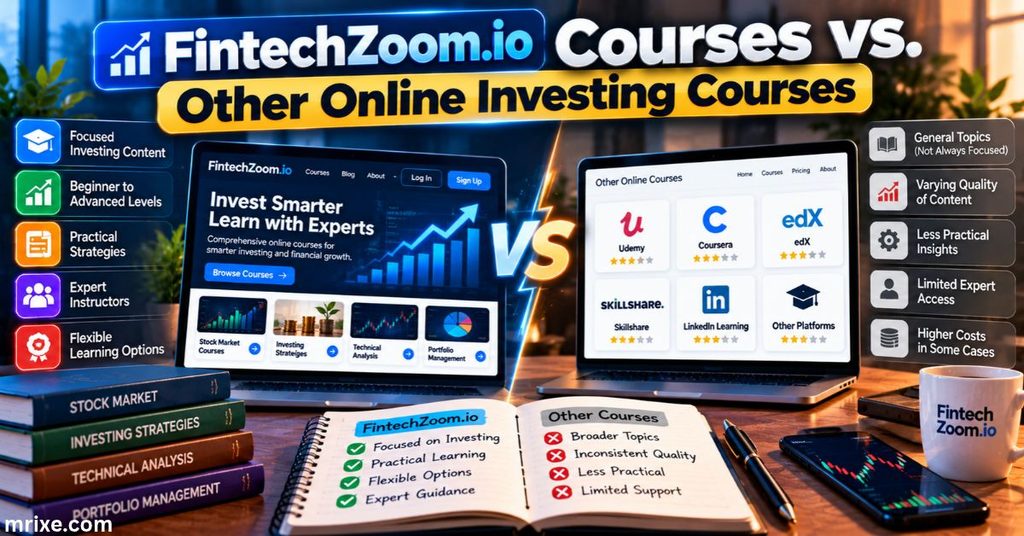
Big marketplaces like Udemy, Coursera, and Investopedia Academy also sell investing lessons. Each works differently. Some give you university-linked material. Others offer individual creators’ classes at one-time prices.
Compare by criteria, not by hype:
| Question | What to check on every platform |
|---|---|
| Who teaches it? | Full name, résumé, track record |
| Is there a preview? | Free sample lessons |
| How many hours? | Total video time |
| What’s the refund rule? | Written policy |
| Are reviews verified? | Platform-collected ratings |
| What does the certificate mean? | Issuer and recognition |
Marketplaces usually show ratings and previews. That’s a transparency edge over a site with a contact-page checkout. Look up current prices on each platform before deciding. They change often.
What to Check Before You Buy FintechZoom.io Courses
Use this list as a pre-purchase routine.
Ask for the Full Syllabus
Request lesson titles and lengths. A module list of “Options” with no minutes tells you nothing.
Verify Instructor Credentials
Get names. Then run them through BrokerCheck, the SEC adviser database, or professional profiles.
Confirm the Current Price
Ask for the quote by email. Save it. Screenshots help too.
Read the Refund Terms
The page mentions a 30-day guarantee. Ask whether it covers each course. Ask how to claim it. Ask how long refunds take.
Check What Support You Actually Receive
Who answers questions? Is it a person or a bot? How fast do they reply?
Look for Independent Student Feedback
Search forums, social media, and review platforms. Weigh comments from verified buyers more than testimonials on the seller’s page.
Can Any Course Make You a Better Trader?
A course can improve your process. It can’t promise profits.
Consider the research. A well-known study of Brazilian futures day traders found that about 97% of those who kept trading for over 300 days lost money. Only a tiny share earned more than minimum wage. Separately, S&P’s SPIVA reports have repeatedly shown that most professional fund managers trail their benchmark index over long periods.
Those results should sober you up. If professionals struggle, a 5-hour course won’t change the odds overnight.
What Education Can Do
Good lessons can help you:
- Avoid common beginner mistakes
- Control position size
- Understand fees and taxes
- Stay calm during drops
- Spot scams faster
The Power of Boring Investing
Compounding is the least exciting and most reliable tool you have. Here’s an example.
Suppose you invest $300 a month for 20 years at a hypothetical 7% annual return. You’d contribute $72,000. The account could grow to roughly $156,000. Real returns vary. Some years will be negative.
The point is simple. Steady habits can matter more than clever trades. The SEC and Investor.gov also warn that any pitch promising guaranteed returns deserves suspicion.
Is the FintechZoom.io Stock Market Course Worth It?
It depends on who you are.
| Buyer type | Worth it? | Reason |
|---|---|---|
| Absolute beginner with debt | Financial Literacy, yes | Builds the base first |
| New long-term investor | Probably | Wide overview in a short time |
| Aspiring day trader | Proceed carefully | Risk is high and depth is limited |
| Experienced trader | Probably not | Too shallow |
| Someone needing credentials | No | Completion certificate only |
You get the best value if you ask for price and instructor details first. Then compare the quote with free resources.
FintechZoom.io Courses FAQs
What is the FintechZoom.io stock market course?
It’s a common search phrase. It usually points to the Stock Market Trading Mastery course or the Investment Mastery course.
How many courses does FintechZoom.io offer?
Three: Financial Literacy, Stock Market Trading, and Stock Market Investing.
How long are the courses?
Financial Literacy runs 3 to 5 hours. Trading runs 4 to 6 hours. Investing runs 7 to 8 hours.
Is the FintechZoom.io stock market course good for beginners?
The provider targets beginners. A beginner with debt or no savings should start with Financial Literacy.
How much does the course cost?
The course pages show no public price. Ask for a written quote.
Does FintechZoom.io offer a refund?
The general course page mentions a 30-day satisfaction guarantee. Get the exact terms in writing.
Does it provide a certificate?
Yes. It’s a completion certificate. It isn’t a professional license.
Does the course teach AI investing tools?
The investing course lists AI and robo-advisers as a topic. That means you’ll learn about them. It doesn’t confirm that you’ll receive AI software.
Can a course guarantee stock market profits?
No. Stocks can lose value. Any promise of guaranteed returns is a red flag.
Is FintechZoom.io a legitimate place to learn about investing?
The site and its course listings exist. Independent proof of student outcomes is limited. Verify instructors and terms before you pay.
Final Verdict: FintechZoom Review Summary
The fintechzoom.io courses offer a tidy, public curriculum across three tracks. They suit beginners who want a short, structured start. The Financial Literacy course makes the best first step. The Investing course comes second. The Trading course deserves the most caution.
The weak spots are transparency issues. You can’t see a price. You can’t see teacher names. You can’t see audited results. Fix those gaps with direct questions before you pay.
If the answers satisfy you, the courses make a reasonable starting point. If they don’t, free sources like Investor.gov will take you surprisingly far.

Nathan Cooper is a humor writer who enjoys creating clever puns, witty jokes, and lighthearted content that brings smiles to readers. He loves sharing fresh, family friendly humor that’s fun, engaging, and easy to enjoy.