
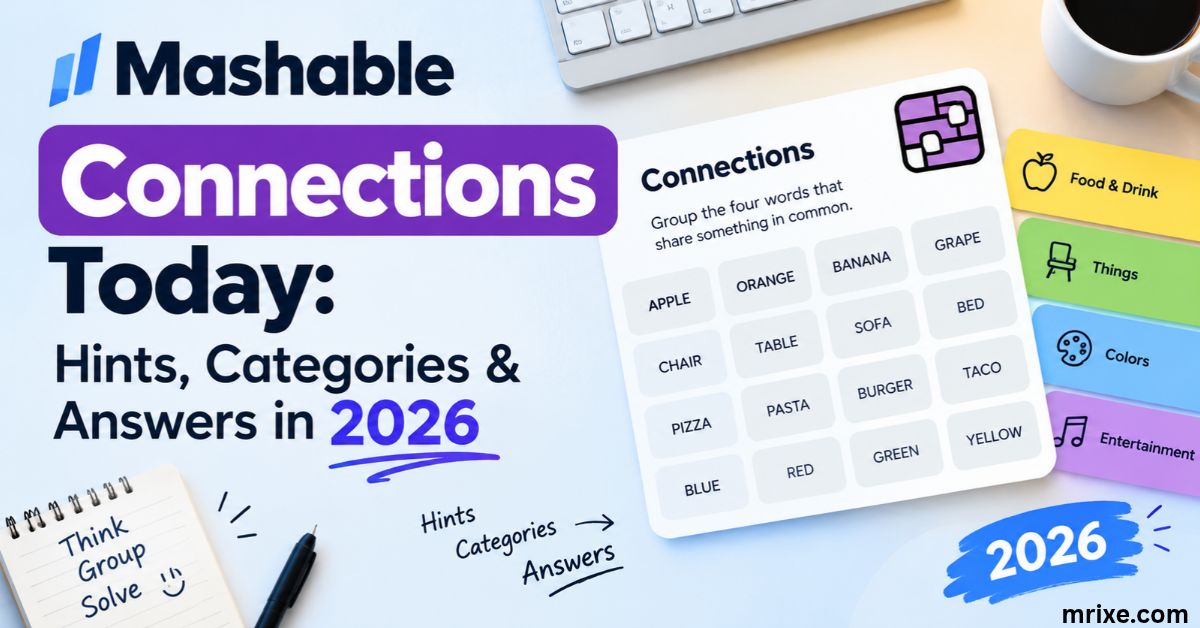
You open the puzzle. Sixteen words stare back. Three look like they belong together, a fourth could go either way, and your brain starts to fizz. Sound familiar?
That’s the daily Connections experience. It’s also why Mashable Connections Today has become a morning habit for millions of players. The guide gives you a nudge when you’re stuck and the full answers when you’ve had enough.
This guide covers how the puzzle works, how Mashable structures its daily help, and how to solve faster without spoiling your own fun. You’ll also find a sample puzzle, a tough-day case study, and a plain-English FAQ.
What Is NYT Connections?
NYT Connections is a daily word-grouping game from The New York Times. You get 16 words. Your job is to sort them into four groups of four, and each group shares a hidden link.
The game launched in beta on June 12, 2023, and became a permanent part of NYT Games soon after. Wyna Liu, an associate puzzle editor at the Times, edits it. You can play it free on the NYT Connections page or inside the NYT Games app.
Here are the basics:
- 16 words appear in a 4×4 grid.
- Four groups hide inside the grid, with four words each.
- Four mistakes are allowed before the game ends.
- One puzzle drops per day and resets at midnight in your time zone.
- Colors reveal each solved group and signal its difficulty.
The rules take thirty seconds to learn. Mastering them takes much longer, and that gap is the whole charm.
By the way, puzzle numbers started at #1 on launch day. Counting forward day by day, today’s grid (October 21, 2026) lands around #1228. That’s more than three years of daily puzzles.
Why the Mashable Connections Hint Today Is So Popular
Mashable didn’t invent Connections, but it quickly became one of the most searched places to get help with it. Why?
First, timing. The puzzle is fresh every day, so help has to be fresh too. Players search the moment they get stuck, often on a phone, often with coffee in the other hand.
Second, format. Mashable’s daily post usually works in layers. You’ll find a hint for each category, then the category names, then the full answers. You choose how much help you want.
Third, tone. The writing reads like a friend at the next desk, not a textbook. That matters when you’re frustrated at 7 a.m.
Fourth, habit. Mashable also covers Wordle, Strands, and other daily games. If you already check one post, checking another feels natural.
Quick tip: Treat the hint post like a ladder. Climb one rung at a time, and stop the moment you can finish alone.
How the NYT Connections Puzzle Works
Let’s walk through a typical session.
You tap four words you think belong together. You hit Submit. If you’re right, the group locks in with a color and a label. If you’re wrong, you lose one of your four mistakes. If three of your four words are right, the game tells you that you’re “one away.” That message is a gift. Use it.
You can also hit Shuffle to rearrange the grid. This helps more than you’d expect. Words in a new position break the visual patterns your eyes get stuck on.
Once you finish, the game shows your results as a grid of colored squares. You can share that grid without spoiling any answers.
Difficulty Colors
Each color marks a difficulty level. Here’s how they break down:
| Color | Difficulty | What to expect |
|---|---|---|
| Yellow | Easiest | Straightforward links, like types of fruit or kitchen tools |
| Green | Easy to medium | Slightly broader links or a mild twist |
| Blue | Medium to hard | Trickier ideas, trivia, or less obvious themes |
| Purple | Hardest | Wordplay, hidden words, or “words that follow X” links |
Don’t treat the colors as a strict order, though. A yellow group can hide a trap. A purple group can feel obvious once you see it. The colors tell you how the editors rated the group, not how your brain will rate it.
Why You Get Stuck in Connections
Almost every stuck player hits one of the same walls. Knowing which one you hit saves a lot of time.
Overlap is the main culprit. The puzzle deliberately places words that fit two or more groups. You might see five words that all seem to belong to one category. Only four do. One of them secretly belongs elsewhere.
Tunnel vision is the second. Once you spot a link, you stop looking. You then force a fifth word into the group and burn a mistake.
Meaning traps come third. Many words carry several meanings. “Bark” can mean a dog’s sound or a tree’s skin. “Pitch” can mean a throw, a sound, or a sales talk. The puzzle loves these.
Wordplay is the fourth. The purple group often doesn’t care what a word means. It cares about how the word looks, sounds, or combines with another word.
Fatigue rounds out the list. After a long day, your brain defaults to the most obvious reading. A short break helps more than staring.
What Makes the Mashable Connections Guide Useful
A good hint guide does more than hand over answers. It teaches you how the editors think.
Here’s what separates a useful guide from a plain answer dump:
- Layered hints let you control spoilers.
- Category reveals tell you the theme without naming the words.
- Full answers give you a safe exit when you’re out of mistakes.
- Clear dates make sure you’re reading help for the right puzzle.
- Explanations show why a tricky group works, which builds skill over time.
Mashable’s daily Connections post follows this layered pattern, which is why many players use it as a training aid and not just a rescue. Read the hints after you finish too. You’ll often spot a link you missed, and that sharpens your eye for tomorrow.
How to Use a Spoiler-Safe Hint Ladder
Here’s a simple way to use Connections hints today without ruining the game:
| Rung | What you read | Spoiler level |
|---|---|---|
| One | Only the hint for the easiest group | Very low |
| Two | Hints for all four groups | Low |
| Three | Category names | Medium |
| Four | One full answer group | High |
| Five | All answers | Total |
Start at rung one. Then close the page and try again. You’ll solve more puzzles on your own than you expect.
Smart Strategy to Solve NYT Connections Faster
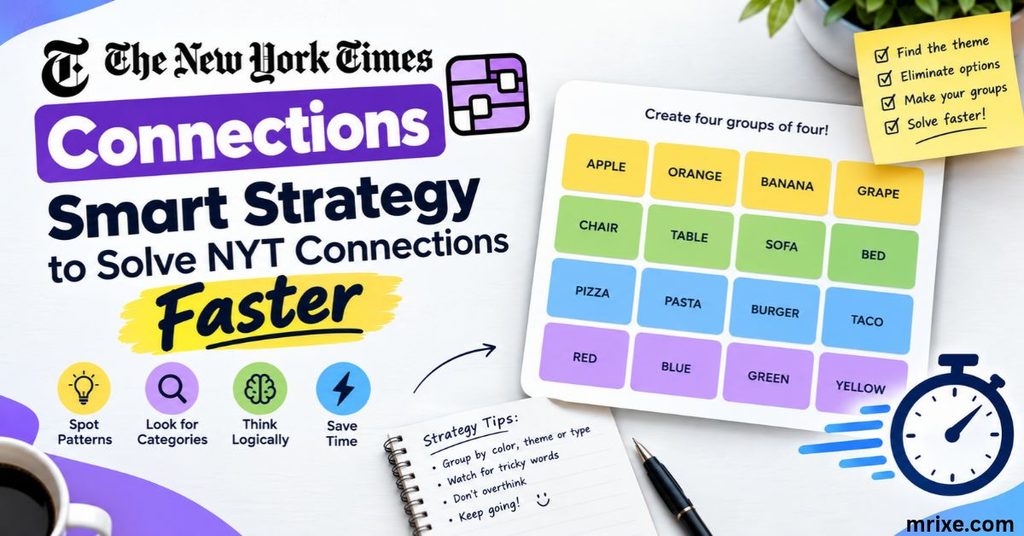
Strategy beats luck here. These five habits work for almost everyone.
Start With Obvious Groups
Look for the group you feel most sure about. Then check whether you have a fifth candidate. If you do, don’t submit yet. Find the word that fits two groups and decide where it really belongs.
Many players grab the first four words that seem to match. That’s the fastest way to waste a mistake.
Focus on Category Thinking
Stop reading words one by one. Instead, ask: “What categories could these words fit?”
Try this quick drill. Pick any word and list three categories it could belong to. “Key” might be a music term, a piece of hardware, a map element, or a computer button. Do that for several words and overlaps pop out fast.
Use the Elimination Method
Solve the groups you’re sure about first. Every group you remove shrinks the grid and clears the clutter.
For example, suppose you lock in two groups. Only eight words remain. Suddenly that tough blue-or-purple split looks far more manageable. Elimination turns a scary 16-word puzzle into a calm 8-word puzzle.
Watch for Trap Words
Trap words are the puzzle’s favorite weapon. You’ll see them as words that fit a theme almost perfectly but belong somewhere else.
Here’s how to spot one:
- Count your candidates for a category.
- If you count five or more, you’ve found a trap.
- Find the word with the most alternate meanings.
- Test that word against the other groups first.
Think in Patterns, Not Words
The hardest groups rarely care about definitions. They care about patterns:
- Words that hide another word inside them
- Words that follow or precede a common word (like fish or fire)
- Words that sound like something else
- Words that change meaning when you add or remove a letter
If a group refuses to make sense, stop thinking about meaning. Start looking at spelling and sound.
Example Breakdown: How Solving Works
Let’s practice with an original sample grid. This is not a real daily puzzle, so there’s no spoiler risk. Here are the 16 words:
CHIP, DRIVE, PUTT, PITCH, NOTE, KEY, SCALE, SHARP, BARK, TRUNK, ROOT, LIMB, FLAT, STAR, CAT, DOG
Try it yourself first. Then read on.
Step One: The “Obvious” Trap
Your eye probably lands on golf first: CHIP, DRIVE, PUTT, PITCH. That looks great. But hold on. PITCH also works as a music word. And the music group has NOTE, KEY, SCALE, SHARP, and FLAT. That’s already five.
So don’t submit anything yet. Two groups are tangled together.
Step Two: Spotting the Theme Group
Look at BARK, TRUNK, ROOT, and LIMB. They’re all parts of a tree. Only four words fit, and none of the others compete. That’s your safest first move.
Submit it. Yellow.
Step Three: The Wordplay Group
Now look at what’s left. DOG, CAT, STAR, and FLAT feel random. But add one word and they click: dogfish, catfish, starfish, flatfish.
That means FLAT belongs here, not in music. That frees the music group: NOTE, KEY, SCALE, SHARP. And PITCH moves back to golf.
Step Four: The Purple Finish
Submit the fish group last, or earlier if you’re confident. Here’s the final sort:
| Group | Words | Link |
|---|---|---|
| Tree parts | BARK, TRUNK, ROOT, LIMB | Parts of a tree |
| Golf shots | CHIP, DRIVE, PUTT, PITCH | Golf strokes |
| Music terms | NOTE, KEY, SCALE, SHARP | Music vocabulary |
| ___fish | FLAT, STAR, CAT, DOG | Words before “fish” |
Notice the lesson. The trap word PITCH, the decoy FLAT, and the doubled meaning of BARK all pointed the wrong way. Solving the cleanest group first and then using elimination untangled everything.
Case Study: How One Streak Survived a Brutal Purple Category
Here’s a composite scenario based on how many daily players describe a tough day. It’s illustrative, not a single real person’s story.
The setup: A player with a 90-day streak opens a puzzle at lunch. She quickly solves the yellow group. Then she uses two mistakes on a green-and-blue mix-up. Only two mistakes remain, and eight words sit in the grid.
The panic: The eight words look unrelated. She stares for five minutes and feels her streak slipping.
The reset: She stops, puts the phone down, and walks for ten minutes. Then she returns and hits Shuffle.
The breakthrough: In the new layout, four words suddenly sit side by side. She notices each one could follow the same short word. That’s a classic purple pattern. She submits, and it locks in.
The finish: The last four words fall into place by elimination. She finishes with two mistakes used and her streak intact.
What can you learn from her?
- Stop spending mistakes when you’re guessing.
- Shuffle to break visual patterns.
- Take a short break because your brain keeps working in the background.
- Try pattern thinking on any leftover group.
Connections Compared to Other NYT Word Games
Connections is one of several daily games from NYT Games. Each tests a different skill. Here’s a quick comparison:
| Game | Core skill | Daily limit | Hint difficulty |
|---|---|---|---|
| Connections | Grouping words by hidden links | 4 mistakes | Medium |
| Wordle | Guessing a five-letter word | 6 guesses | Low |
| Strands | Finding themed words in a letter grid | Unlimited guesses, hints earned | Medium |
| Spelling Bee | Making words from seven letters | No limit | Medium to high |
| The Mini | Fast crossword | No limit | Low |
NYT also offers a Sports Edition of Connections, launched in 2025, built around athletes, teams, and sports terms. The rules match the original. Only the vocabulary changes.
Connections stands apart because it rewards lateral thinking more than vocabulary size. You can have a huge vocabulary and still struggle. You can have a modest one and play brilliantly if you spot patterns.
Why Daily Practice Matters
You wouldn’t expect to run a 10K on your first jog. Connections works the same way.
Playing daily trains three skills:
- Pattern recognition. You start seeing “___fish” or “hidden word” links faster.
- Editor awareness. You learn which themes recur, like homophones, brand names, or slang.
- Mental flexibility. You get better at dropping a wrong idea quickly.
Most players notice the change within a few weeks. Puzzles that once felt impossible start to feel merely tricky.
Here’s a simple practice routine:
- Play once a day, ideally at the same time.
- Before reading any hint, give yourself five full minutes.
- After finishing, read the explanation for any group you missed.
- Write down one new pattern type you learned.
That last step sounds tiny. Yet over a month, you’ll build a personal playbook.
Common Mistakes to Avoid
Even strong players repeat the same errors. Here are the big ones, plus fixes:
| Mistake | Why it hurts | Better move |
|---|---|---|
| Submitting the first group you see | Trap words often hide inside it | Look for a fifth candidate first |
| Ignoring “one away” | You abandon a nearly right group | Swap only one word |
| Guessing when stuck | You burn mistakes without learning | Shuffle or step away |
| Reading all hints at once | You lose the satisfaction of solving | Use the hint ladder |
| Forcing meanings on purple groups | Wordplay isn’t about definitions | Check spelling and sound |
| Rushing late at night | Tired brains default to obvious readings | Play when you feel fresh |
Of all these, “one away” is the most wasted clue. When the game says it, three of your four words are correct. Swap just one word, and you’ll often crack the group on the next try.
Advanced Thinking Technique
Ready to level up? Try the three-pass method.
Pass one: scan. Read all 16 words quickly. Don’t try to solve anything. Just notice any word that jumps out as odd, double-meaning, or unusual.
Pass two: link. Pair words that feel connected. Then check what other words share the link. If more than four match, you’ve found a trap.
Pass three: break. Take your most suspicious word and test it against every group. The word that fits the most categories usually belongs to the hardest one.
Then add one more trick: solve backward from purple. If you can spot the wordplay group early, the other three often fall into place easily. Look for words that follow a common word, hide a smaller word, or share a quirky spelling feature.
Pro move: When a group won’t click, say the words out loud. Sound-based links, such as homophones, show up much faster when you hear them.
Why Every Puzzle Feels Different
Some days Connections feels like a gentle stroll. Other days it feels like a wrestling match. Why does the difficulty swing so much?
The editors vary the style on purpose. One puzzle may lean on pop culture. The next may lean on science, wordplay, or everyday objects. A theme you love shows up one day, and a theme you’ve never heard of shows up the next.
Your own knowledge changes the experience. A sports fan breezes through a game that stumps a casual viewer. A musician sees a music group instantly. Personal experience shifts how hard each group feels.
Trap density changes. Some puzzles have only one or two overlapping words. Others tangle three groups together.
Your mood matters too. Sleep, stress, and time of day all affect pattern recognition.
That variety keeps the game fresh. It also explains why a Mashable-style hint post stays useful. Each day brings a new set of obstacles.
Where Mashable Connections Today Fits Into Your Routine
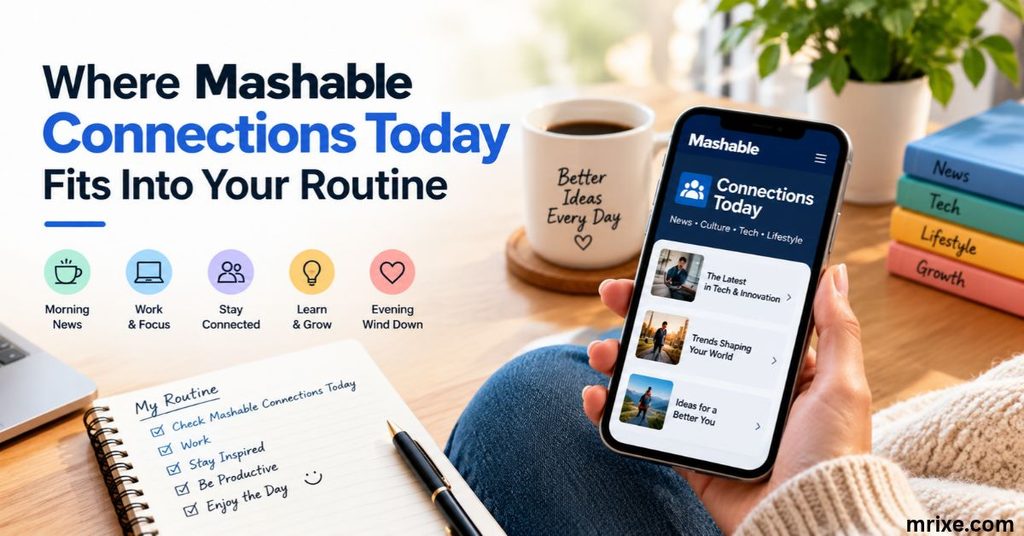
Think of the daily hint post as a coach, not a crutch.
Here’s a routine that works well:
- Play cold. Solve what you can in five minutes.
- Read only the first hint if you’re stuck.
- Try again before climbing the ladder further.
- Check the answers only when you’re out of ideas.
- Read the explanation for any group you missed.
Mashable also publishes help for other daily games. That makes it a handy one-stop morning stop if Wordle and Strands are part of your habit. You can visit the Mashable website and look for the daily games coverage.
FAQs
What time does Connections reset?
The puzzle resets at midnight in your local time zone. A new grid appears right after. Your streak continues as long as you finish a puzzle each day.
How many mistakes can I make?
You get four mistakes. After the fourth, the game ends and reveals the remaining groups.
Are the colors always in the same order?
The colors always mean the same level: yellow, green, blue, then purple from easiest to hardest. But players don’t always find them in that order. Many people solve purple first when the wordplay is easy to spot.
Is there a way to use Mashable Connections hint today without spoilers?
Yes. Read the category hints first and skip the category names and answers. Each hint nudges you toward a group without naming the words. Use them one at a time.
Why do some groups feel unfair?
Most “unfair” groups rely on a meaning, spelling pattern, or piece of trivia you didn’t expect. Check the explanation after the game. You’ll usually see how the clue worked, and that makes the next one easier.
Can I play old Connections puzzles?
NYT offers an archive for subscribers. You can replay past puzzles and practice patterns. Subscribers also get extra features, like stat tracking. Check the NYT Games page for current access details.
Is Connections good for your brain?
Puzzle games build habits like focus and flexible thinking. No single game turns you into a genius. But a daily puzzle gives your mind a small workout, and consistent practice does improve how quickly you spot patterns in this specific game.
How can I improve fast?
Follow three rules. Play daily. Review every miss. Learn pattern types, like hidden words and “___ + word” links. Most players see a real jump within a month.
What’s the difference between Connections and Connections Sports Edition?
The rules match. The Sports Edition simply builds its groups around sports, such as teams, players, equipment, and terms. If you love sports trivia, it’s a great second daily puzzle.
Where can I find the NYT Connections answer today?
Many players check Mashable’s daily Connections post, which lists hints, categories, and answers in layers. You can also play the puzzle itself on the NYT Games site or app.
Final Thoughts
Connections works because it’s simple on the surface and deep underneath. Sixteen words. Four groups. One tricky twist per day.
You’ve now got a full toolkit. Start with the group you’re surest about. Hunt for trap words. Use elimination. Shuffle when you feel stuck. Think in patterns once meaning stops helping.
And when a puzzle beats you, don’t sweat it. That’s part of the fun. Mashable Connections Today exists to catch you when you slip, and the real prize is the sharper eye you build along the way.
Come back tomorrow. A fresh grid is waiting.

Nathan Cooper is a humor writer who enjoys creating clever puns, witty jokes, and lighthearted content that brings smiles to readers. He loves sharing fresh, family friendly humor that’s fun, engaging, and easy to enjoy.